
Key takeaways
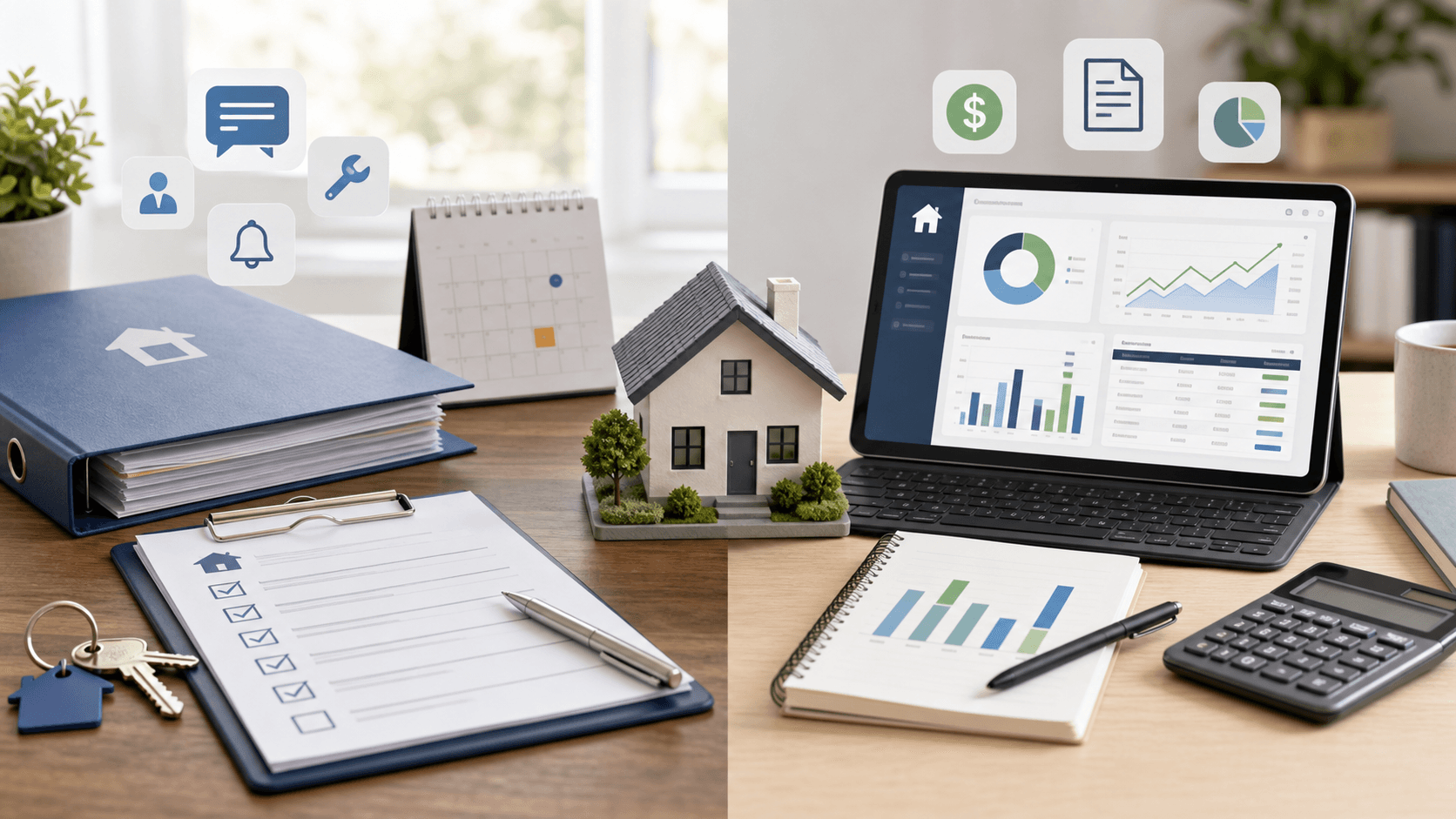
- Property management software primarily supports operational workflows such as leasing, renter communication, maintenance, and rent collection.
- Rental property accounting software focuses on financial records and reporting, including rental income, expenses, balances, cash flow, profitability, and property-level performance.
- General accounting software can support rental bookkeeping but may require configuration to organize records by property, rental, renter, or portfolio.
- Some landlords use both operational and financial software rather than relying on one platform for every workflow.
- The right software depends on whether the landlord primarily needs operational management, financial visibility, or both; individual product capabilities vary.
On this page
- Introduction
- What Is Property Management Accounting Software?
- What Is Property Management Software?
- What Is Rental Property Accounting Software?
- Rental Property Accounting Software vs. General Accounting Software
- Property Management Software vs. Rental Property Accounting Software
- Property Management Software With Accounting Features
- Property Management Software Strengths
- Rental Property Accounting Software Strengths
- What Should Landlords Look for in Rental Accounting Software?
- Accounting Software for Small Landlords
- Bookkeeping vs. Accounting for Rental Properties
- Which Problems Are You Trying to Solve?
- When Property Management Software May Not Provide Enough Financial Detail
- When a Landlord May Prefer Accounting-Focused Software
- Can Landlords Use Both?
- Property Accounting System: What Does That Mean?
- Where PropioLedger Fits
- Final Thoughts
- Educational Disclaimer
- Frequently Asked Questions
Introduction
Landlords searching for property management accounting software often encounter several overlapping categories: property management platforms, general accounting software, and rental property accounting software.
Property management software primarily supports operational workflows such as leasing, renter communication, maintenance coordination, and rent collection. General accounting software supports financial bookkeeping and accounting across many types of businesses. Rental property accounting software organizes financial information around properties, rentals, renters, rent charges, payments, balances, expenses, cash flow, and property performance.
Product capabilities overlap and vary. Understanding each category’s emphasis can help you evaluate specific tools against the work you need to do, rather than choosing by a category label alone.
What Is Property Management Accounting Software?
“Property management accounting software” is often used as a broad term for software that helps landlords or property managers organize the financial side of rental operations. It is not necessarily one standardized product category.
The phrase may describe a property management platform with bookkeeping features, rental-specific accounting software, a system combining operational and financial workflows, or accounting tools used alongside a property management system.
Operational and accounting depth differ significantly between products. Check which records, reports, and processes are actually included—and whether they meet the needs of your rental business.
What Is Property Management Software?
Property management software is designed to help landlords and property managers handle day-to-day rental operations. Depending on the product, capabilities may include applications, leasing, lease renewals, renter communication, maintenance requests or work orders, vendor coordination, rent collection, renter portals, and move-in/move-out workflows.
Its operational records can also support financial work. For example, a rent roll summarizes rental and occupancy information, but does not replace the broader financial records a landlord or accountant may need.
What Is Rental Property Accounting Software?
Rental property accounting software is designed to organize financial records around rental properties. Instead of treating property context as a separate worksheet, it may connect financial activity to properties, rentals, renters, and the portfolio.
Common capabilities may include rental income tracking, property expense tracking, rent charges, payments, rental ledgers, open and past-due balances, recurring expenses, cash flow, profitability, and property-level or portfolio reporting. Availability and calculation methods vary by product.
The Rental Property Accounting Guide explains the underlying records and distinctions to understand before comparing software.
Rental Property Accounting Software vs. General Accounting Software
General accounting software supports many types of businesses. Rental-specific accounting software organizes information around rental property concepts. Neither label alone tells you how complete a product’s accounting functionality is.
General accounting software can be an appropriate choice for landlords, especially when configured to their needs or used with an accountant or bookkeeper. Classes, projects, tracking categories, or similar tools may organize property activity, depending on the product.
Use this comparison as a set of questions to investigate. A product may offer a capability directly, through configuration, or through another connected tool.
| Capability / Focus | General Accounting Software | Rental Property Accounting Software |
|---|---|---|
| General business bookkeeping | Commonly supports records across business types | Focuses on rental financial records; broader bookkeeping depth varies |
| Chart of accounts | Commonly supported; structure is configurable | May use rental categories or a chart of accounts; verify the accounting model |
| Bank/account activity | Commonly supported; bank feeds and reconciliation vary | Bank connections, imports, and reconciliation vary by product |
| Property-level organization | May require classes, projects, or other configuration | Usually organized around rental properties |
| Rental/unit organization | May require configuration or a separate system | May include rental- or unit-specific records |
| Renter records | May use customer records or custom fields | May connect renter records to rentals and financial activity |
| Rent charges | May use invoices or recurring transactions | May support rental-specific charge schedules |
| Rent payments | May record receipts against customer invoices | May associate payments with rentals and charges |
| Rental ledger | May require configured reports or supporting records | May provide a charge-and-payment history for each rental |
| Open/past-due balances | Receivables and aging commonly available; setup matters | May distinguish unpaid rental charges from amounts already due |
| Property expense tracking | Commonly supports expenses; property allocation needs setup | May organize one-time and recurring costs by property |
| Property-level cash flow | May require property tracking and report configuration | May provide property-focused cash movement reports |
| Rental profitability | May use configured income/expense reports | May compare rental income and property expenses directly |
| Portfolio comparison | May require grouped reports or exports | May compare multiple properties using consistent rental metrics |
| Accountant/export workflows | Commonly offers reports or exports; access options vary | Report formats, exports, and accountant workflows vary |
Property Management Software vs. Rental Property Accounting Software
The table below compares typical priorities, not fixed feature boundaries. Confirm the available features, reporting basis, integrations, and subscription requirements in each product you evaluate.
| Capability / Focus | Property Management Software | Rental Property Accounting Software |
|---|---|---|
| Primary purpose | Coordinate rental operations | Organize rental financial records and reporting |
| Applications | May support application intake and related workflows | May rely on a separate operational tool |
| Leasing | May support documents, signing, and renewals | May record rental terms without a full leasing workflow |
| Renter communication | May include messages, notices, or portals | May include financial notices; communication tools vary |
| Maintenance/work orders | Common operational focus; depth varies | May track repair expenses without managing work orders |
| Vendor coordination | May schedule work and coordinate service providers | May record vendor costs without scheduling work |
| Rent collection | May include online collection and payment processing | May record payments; payment processing is a separate capability to verify |
| Rental income tracking | Often included alongside collection tools | A common financial-records focus |
| Expense tracking | May include expenses, bills, and vendor payments | A common focus; recurring and one-time expense support varies |
| Rental ledger | May connect resident activity and charges | May focus on rental charges, payments, and adjustments |
| Open/past-due balances | May support balance and delinquency reports | May offer charge-based balances and due-date distinctions |
| Cash flow reporting | Report scope and accounting basis vary | Common focus; property detail and calculation basis vary |
| Profitability reporting | May offer income/expense and owner reports | Common focus; included income and expense categories vary |
| Property-level financial reporting | May be available within financial modules | Usually a central organizing principle |
| Portfolio financial comparison | May support portfolio or owner summaries | May compare properties with consistent financial metrics |
| Financial forecasting | May forecast rents, budgets, or occupancy | May forecast income or cash activity; assumptions vary |
| Typical use case | Landlords needing coordinated operational workflows | Landlords prioritizing financial organization and visibility |
Property management software tends to be operations-first. Rental property accounting software tends to be financial-records and reporting-first. Some platforms combine both; evaluate the actual workflow rather than assuming a category guarantees a feature.
Property Management Software With Accounting Features
Many property management platforms include financial functionality. Depending on the product, this may include rent collection, income and expense records, owner statements, accounting or general-ledger capabilities, and financial reporting.
The depth varies. Ask whether the financial functionality answers your questions: can you explain an unpaid balance, identify property costs, compare periods, and produce the records your accountant needs? An “accounting” feature label does not establish that every financial workflow is covered.
If you need formal statements, check the requirements for an income statement and a balance sheet separately. A collection summary or property performance dashboard is not automatically a complete set of financial statements.
Income statement needs
The Rental Property Income Statement guide explains how income, expenses, and profit or loss relate over a reporting period.
Balance sheet needs
The Rental Property Balance Sheet guide explains assets, liabilities, and owner’s equity at a particular date.
Property Management Software Strengths
Property management software is often strongest when landlords need help coordinating people, processes, and property-related activities. Depending on the product, operational strengths may include:
- Leasing workflows for applications, lease signing, renewals, move-ins, and move-outs
- Renter communication and notifications
- Maintenance request tracking, vendor coordination, and repairs
- Rent collection and payment processing
- Renter portals for self-service access
Rental Property Accounting Software Strengths
Rental property accounting software is often strongest when landlords need a clearer financial view of income, expenses, balances, cash flow, profitability, and portfolio performance. Look for evidence of the following capabilities in the specific product:
- Income tracking to understand rental revenue
- Expense tracking to monitor property costs
- Rental ledger management for charges, payments, balances, and collections
- Cash flow analysis across properties and periods
- Profitability reporting to identify stronger and weaker performers
- Portfolio visibility using consistent financial metrics
What Should Landlords Look for in Rental Accounting Software?
Use a representative rental, a partial payment, and a recurring expense in a product demo. Follow the records into reports and an export so you can judge the workflow, not just a feature list.
Property-level organization
Can financial activity be associated with specific rental properties without keeping a separate allocation spreadsheet?
Rental income tracking
Can you distinguish rental income, scheduled charges, and payments actually received? Check how the product handles deposits and other non-rent receipts.
Expense tracking
Can recurring and one-time property expenses be organized by property, category, and reporting period?
Rental balances
Can you trace charges and payments to open balances and past-due amounts? Check whether future charges appear as open without being treated as overdue.
Cash flow
Can you understand cash moving into and out of individual properties, and see which receipts and payments a report includes?
Profitability
Can income and expenses be compared to understand property performance? Ask how the report treats timing and which costs it includes.
Portfolio reporting
Can multiple properties be reviewed and compared using consistent definitions and periods?
Historical reporting
Can you review financial performance across useful periods and explain changes without overwriting the underlying transaction history?
Import and export
Can you bring in existing records, review imports before saving, and export useful data when you need to work with another system or professional?
Accounting Software for Small Landlords
Smaller and self-managing landlords may have different requirements from professional property managers coordinating large portfolios and teams. Simplicity, easy setup, low administrative overhead, and exportability may matter as much as a long list of features.
Common priorities include property-level organization, rental income and expense tracking, clear balances, and useful financial reports. There is no universal property or unit cutoff that makes one category the right choice.
Consider your existing processes and the work you want to reduce. A general accounting tool configured with a bookkeeper, a rental-specific tool, or an operational platform with suitable financial features may each fit different needs.
Bookkeeping vs. Accounting for Rental Properties
Bookkeeping generally involves recording and organizing financial transactions. Accounting involves interpreting, summarizing, reconciling, and reporting financial information. The activities overlap, and software may support parts of either or both.
The Rental Property Bookkeeping Guide covers the transaction records that make later reporting more useful. The accounting guide linked earlier explains how those records support a broader financial review.
Related Guides
Rental Property Accounting GuideWhich Problems Are You Trying to Solve?
Choosing software starts with the problem you are trying to solve. Use these starting points to shortlist categories, then test the relevant workflow in individual products.
| If you primarily need… | Software category to consider |
|---|---|
| Applications and leasing | Consider property management software with the required application and lease tools. |
| Renter communication | Consider an operational platform with suitable messaging or portal features. |
| Maintenance/work orders | Consider property management software with maintenance coordination. |
| Rent collection workflows | An operational platform or collection service may fit; confirm payment-processing support. |
| Rental income/expense organization | Consider rental accounting software or general accounting software configured for rentals. |
| Rental balances | Consider a product with rental ledgers and clear charge/payment allocation; category alone is not enough. |
| Cash flow visibility | Consider financial reporting tools with the property detail and cash definitions you need. |
| Profitability reporting | Consider rental accounting or appropriately configured general accounting tools. |
| Property-level financial reporting | A rental-specific tool or a suitable financial module may fit. |
| Both operational and financial workflows | Consider a combined platform or complementary systems; integration quality matters. |
When Property Management Software May Not Provide Enough Financial Detail
Some landlords find that their operational software does not provide the financial reporting or property-level analysis they need. They may know which leases are active and which maintenance requests are open, but still need more detail to answer financial questions. This varies by product and configuration.
Questions such as which properties are generating positive cash flow, how much rent remains unpaid, or how vacancy affects performance may call for different reports or supporting records. Check the current platform’s available financial features before deciding whether another tool is needed.
The Rental Property Reporting Guide can help identify the reports that answer these questions.
When a Landlord May Prefer Accounting-Focused Software
A self-managing landlord who already has workable processes for leasing, maintenance, communication, and rent collection may primarily need stronger financial organization and reporting.
In that situation, an accounting-focused tool may fit the missing piece: income, expenses, balances, cash flow, and portfolio performance. This is not universally better than an operational platform; the choice depends on existing workflows, reporting requirements, and the work of maintaining multiple systems.
Can Landlords Use Both?
Yes. Many landlords use both operational and financial tools. For example, one system may handle leasing and maintenance while another system handles financial reporting and portfolio analysis.
Integrations, imports, exports, and consistent property and rental identifiers matter when using multiple systems. Decide which system owns each record, how payments and corrections move between them, and how you will reconcile totals without duplicating activity.
The right combination depends on portfolio size, management style, existing workflows, and which decisions the landlord needs software to support.
Property Accounting System: What Does That Mean?
A property accounting system can broadly mean the software and processes used to organize rental-property financial information: rental income, property expenses, balances or receivables, property-level records, cash flow, reporting, and portfolio financial information.
The accounting architecture varies by product. Some tools maintain a complete double-entry general ledger; others organize rental activity and supporting reports that feed a separate accounting process. Ask which records the system maintains, how totals reconcile, and which tasks remain with your accountant or other software.
Where PropioLedger Fits
PropioLedger is designed for landlords who want rental-specific financial organization and reporting without requiring a full property-management operations platform.
It organizes properties, rentals, and renter records, with rental ledgers that connect rent charges, recorded payments, open balances, and past-due amounts. Open Balance includes unpaid visible charges, including charges not yet due; Past Due includes unpaid charges whose due date is today or earlier.
Landlords can track one-time and recurring property expenses, review cash flow and property profitability, and use property-level and portfolio reports across supported reporting periods. Payment recording tracks payments received; it should not be confused with online payment processing.
The Import Center supports reviewed CSV and Excel imports for properties, rentals, payments, expenses, and recurring expenses. Report exports provide supporting information for offline review and accountant workflows; available export formats vary by report.
PropioLedger does not provide full-service property management, applicant screening, maintenance management, a full leasing workflow, a complete double-entry general ledger, tax preparation, professional accounting services, or automatic property valuation.
Final Thoughts
Property management software and accounting software emphasize different work, with considerable overlap between products. General accounting software can support rental businesses, while rental-specific tools organize records around properties and rentals.
Choose according to the operational and financial questions you need to answer. Review actual workflows, reporting definitions, and how you can move your records before committing to a system.
Rental Property Financials Without a Full Property Management Platform
PropioLedger helps landlords organize rental income, expenses, payments, balances, cash flow, and property-level reporting in one rental-focused system.
Educational Disclaimer
This guide is for general educational purposes and is not tax, accounting, legal, or financial advice. Landlords should consult a qualified professional for guidance specific to their situation.