
Key takeaways
- Gross rent multiplier compares property price with gross annual rental income.
- GRM is calculated by dividing property price by gross annual rent.
- A lower GRM means a lower property price relative to gross rent, but it does not automatically mean a property is a better investment.
- GRM ignores operating expenses, vacancy, financing, and many other factors that affect actual profitability.
- GRM is most useful as an initial screening metric alongside deeper measures such as NOI, cap rate, cash flow, cash-on-cash return, and ROI.
On this page
- What Is Gross Rent Multiplier?
- How Gross Rent Multiplier Works
- Gross Rent Multiplier Formula
- Gross Rent Multiplier Example
- Comparing Rental Properties Using GRM
- Why a Lower GRM Is Not Always Better
- What Is a Good Gross Rent Multiplier?
- Gross Rent Multiplier vs. Cap Rate
- Gross Rent Multiplier vs. Cash Flow
- Gross Rent Multiplier vs. Cash-on-Cash Return
- Gross Rent Multiplier vs. ROI
- GRM and the 1% Rule
- Can You Calculate Property Value From GRM?
- When Gross Rent Multiplier Is Useful
- Limitations of Gross Rent Multiplier
- Actual Rent vs. Market Rent When Calculating GRM
- Using GRM With Other Rental Property Metrics
- How PropioLedger Helps With Rental Property Analysis
- Educational Disclaimer
- Frequently Asked Questions
What Is Gross Rent Multiplier?
Gross rent multiplier (GRM) compares a rental property's price or value with its gross annual rental income. Investors commonly use it as a quick screening metric when comparing rental properties.
The basic formula is Gross Rent Multiplier = Property Price ÷ Gross Annual Rental Income.
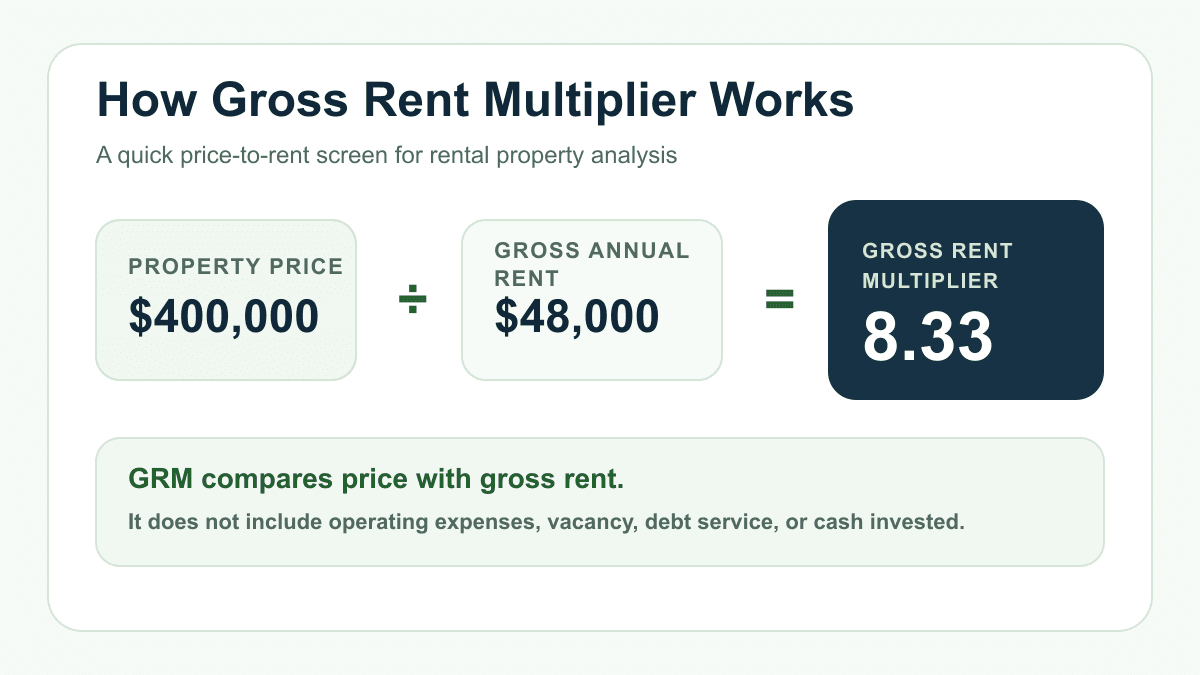
For example, a $400,000 property with $4,000 of gross monthly rent has $48,000 of gross annual rent. $400,000 divided by $48,000 equals 8.33, so the Gross Rent Multiplier is 8.33.
A GRM of 8.33 means the property's price is approximately 8.33 times its gross annual rental income.
GRM does not account for operating expenses, vacancy, financing, taxes, insurance, repairs, or other differences in property economics. It is best treated as a quick screening and comparison metric rather than a complete profitability analysis.
GRM is not annual return, profit margin, cap rate, cash-on-cash return, ROI, or a measure of cash flow. It has no percentage sign. A result such as 8.3 is a multiplier, not 8.3%.
Gross Rent Multiplier = Property Price ÷ Gross Annual Rental Income
| Input | Amount |
|---|---|
| Property price | $400,000 |
| Gross monthly rent | $4,000 |
| Gross annual rent | $48,000 |
| GRM calculation | $400,000 ÷ $48,000 = 8.33 |
| Gross Rent Multiplier | 8.33 |
How Gross Rent Multiplier Works
GRM is intentionally simple. It connects the price side of a rental property with the rent side before adjusting for expenses, vacancy, financing, or investor-specific assumptions.
That simplicity is why GRM can be useful early in acquisition review. It can help an investor decide whether a listing is worth deeper analysis, but it should not be the only number used to make a purchase decision.
GRM compares price with gross rent. It does not include operating expenses, vacancy, debt service, or cash invested.
Gross Rent Multiplier Formula
The gross rent multiplier formula is GRM = Property Price ÷ Gross Annual Rental Income.
Property price is commonly the purchase price being evaluated for an acquisition. For an existing rental property, an investor may use an estimated current property value depending on the purpose of the analysis.
Gross annual rental income generally means rental income before operating expenses. For a property renting for $3,000 per month, $3,000 multiplied by 12 equals $36,000 of gross annual rent.
Be careful not to mix monthly rent and annual rent. The standard GRM formula in this guide uses annual rent.
Property Price
For acquisition analysis, property price is commonly the purchase price being evaluated.
For an existing property, an investor may use estimated current property value instead. The important point is consistency: be clear about which value is being used when comparing properties.
Gross Annual Rental Income
Gross annual rental income is rent before operating expenses. If monthly rent is $3,000, annual gross rent is $36,000.
Projected rent, asking rent, and actual rent can produce different GRM results. Label the rent assumption clearly before comparing one property with another.
GRM = Property Price ÷ Gross Annual Rental Income
Related Guides
Use the Gross Rent Multiplier CalculatorGross Rent Multiplier Example
Assume a fictional Oak Street Rental has a purchase price of $350,000 and expected monthly rent of $3,000. Annual gross rent is $36,000.
$350,000 divided by $36,000 equals 9.72, so GRM is 9.72.
The property's purchase price is approximately 9.72 times its annual gross rental income. This does not mean the investor earns a 9.72% return. GRM is a price-to-rent multiple, not a return percentage.
| Item | Amount |
|---|---|
| Purchase price | $350,000 |
| Monthly rent | $3,000 |
| Annual gross rent | $36,000 |
| Calculation | $350,000 ÷ $36,000 = 9.72 |
| GRM | 9.72 |
Comparing Rental Properties Using GRM
GRM can help investors compare multiple rental properties quickly when the properties are reasonably similar and the rent assumptions are measured the same way.
Based only on GRM, Property A has the lowest price relative to its gross rent. That does not automatically make Property A the best investment. The next step is to review expenses, vacancy, NOI, financing, cash flow, and other return metrics.
| Property | Price | Annual Gross Rent | GRM |
|---|---|---|---|
| Property A | $300,000 | $36,000 | 8.33 |
| Property B | $400,000 | $44,000 | 9.09 |
| Property C | $500,000 | $50,000 | 10.00 |
Why a Lower GRM Is Not Always Better
A lower GRM means the property price is lower relative to gross rent, but GRM does not know what it costs to own or operate the property.
Two properties with similar gross rent can have very different property taxes, insurance, repairs, maintenance, HOA fees, utilities, management costs, vacancy, capital expenditure requirements, and financing costs.
Property A could have a lower GRM and high expenses, while Property B could have a higher GRM and lower expenses. Property B could ultimately produce stronger NOI or cash flow. GRM does not know the difference.
What Is a Good Gross Rent Multiplier?
There is no universally good GRM. A "good" gross rent multiplier depends on the market, property type, property condition, investor goals, and the assumptions used.
Typical GRMs can vary based on local property prices, local rents, neighborhood, property condition, growth expectations, the interest-rate environment, and investor demand.
GRM is most useful when comparing reasonably similar properties in the same market using consistent assumptions. Investors should then evaluate expenses, NOI, financing, cash flow, and return metrics before drawing conclusions.
Gross Rent Multiplier vs. Cap Rate
GRM and cap rate both compare property value with income, but they use different income measures.
GRM uses gross rental income and ignores operating expenses. Cap rate uses net operating income, or NOI, which accounts for operating expenses before financing.
Because cap rate includes operating expenses through NOI, it generally provides more information about operating performance. GRM is quicker to calculate because it requires less information.
| Metric | GRM | Cap Rate |
|---|---|---|
| Formula | Property Price ÷ Gross Annual Rent | Annual NOI ÷ Property Value × 100 |
| Uses property value? | Yes | Yes |
| Uses gross rent? | Yes | No, except as an input toward NOI when calculating from income |
| Uses NOI? | No | Yes |
| Accounts for operating expenses? | No | Yes |
| Includes financing? | No | No, generally before debt service |
| Result format | Multiplier | Percentage |
| Best used for | Quick price-to-rent screening | Operating yield comparison before financing |
Gross Rent Multiplier vs. Cash Flow
GRM is a price-to-rent ratio. Cash flow measures actual cash remaining after relevant property cash inflows and outflows.
A property can have an attractive-looking GRM but poor cash flow because of high expenses, high debt service, vacancy, repairs, or other cash obligations.
Investors often use GRM to decide whether to run a more detailed cash flow analysis.
Gross Rent Multiplier vs. Cash-on-Cash Return
GRM compares property price with gross rent. Cash-on-cash return compares annual pre-tax cash flow with the actual cash invested in the rental property.
Cash-on-cash return reflects financing through cash flow and invested cash. GRM ignores financing and operating expenses, uses property price or value, and produces a multiplier instead of a percentage return.
| Topic | GRM | Cash-on-Cash Return |
|---|---|---|
| Primary question | How expensive is the property relative to gross rent? | How much annual cash yield does invested cash produce? |
| Uses property price/value? | Yes | Not directly as the denominator |
| Uses gross rent? | Yes | Only as part of cash flow inputs |
| Uses cash invested? | No | Yes |
| Includes expenses? | No | Yes, through cash flow |
| Reflects financing? | No | Yes, through debt service and invested cash |
| Result format | Multiplier | Percentage |
Gross Rent Multiplier vs. ROI
GRM is a screening multiple. ROI is a return measurement.
The PropioLedger Rental ROI Calculator uses annual cash flow, principal paydown, and estimated appreciation relative to cash invested. That answers a very different question from GRM.
GRM can help screen properties quickly. ROI analysis can help an investor estimate broader annual return based on specific assumptions.
GRM and the 1% Rule
The 1% rule compares monthly rent with property purchase price. For example, 1% of a $400,000 property is $4,000 per month.
Both GRM and the 1% rule use price and gross rent while ignoring many property expenses. Neither should be treated as a complete investment test.
For a property that rents at exactly 1% of purchase price per month, annual rent equals 12% of purchase price. The GRM is approximately 8.33 because 1 divided by 0.12 equals 8.33.
That relationship does not make the 1% rule a required threshold. It only shows how two simple rent-to-price screening tools connect mathematically.
Can You Calculate Property Value From GRM?
GRM can also be rearranged to create a simplified value estimate: Estimated Property Value = GRM × Gross Annual Rental Income.
For example, if comparable rental properties trade around a 9.0 GRM and a property has $40,000 of annual gross rent, the simplified GRM-based value estimate is $360,000.
This is not an appraisal. Actual property value can depend on comparable sales, property condition, location, market demand, property characteristics, financing environment, and many other factors.
Estimated Property Value = GRM × Gross Annual Rental Income
| Input | Amount |
|---|---|
| Comparable-market GRM | 9.0 |
| Property annual gross rent | $40,000 |
| Estimated value using GRM | $360,000 |
When Gross Rent Multiplier Is Useful
GRM is useful when an investor wants a quick first-pass comparison before spending time on deeper analysis.
Practical use cases include screening multiple listings, comparing similar rental properties, comparing price relative to gross rent, identifying properties worth deeper analysis, evaluating whether asking price and rent appear broadly aligned, and creating an acquisition shortlist.
GRM is best used to answer "Should I analyze this property further?" rather than "Should I buy this property?"
Limitations of Gross Rent Multiplier
GRM is useful because it is simple, but that same simplicity creates important limitations.
Projected rent should not automatically be treated as actual rent. A property can look better on a projected GRM basis if the rent assumption is optimistic or depends on future renovations, market movement, or lease-up success.
| Limitation | Why It Matters |
|---|---|
| Ignores operating expenses | Two properties with the same rent can have very different operating costs. |
| Ignores vacancy | Lost rent can reduce actual income and performance. |
| Ignores financing | Debt service can materially change cash flow and investor returns. |
| Ignores capital expenditures | Major repairs or replacements can require substantial cash. |
| Ignores property condition | A low GRM property may need expensive work. |
| Ignores appreciation | Future value changes are outside the formula. |
| Ignores principal paydown | Debt reduction can affect equity but not GRM. |
| Does not measure cash flow | GRM does not show dollars left after obligations. |
| Does not measure actual return | It is a multiplier, not a yield or profit percentage. |
| Can be misleading across markets or property types | Different locations and property types often trade at different rent multiples. |
| Depends on accurate rent assumptions | Overstated rent can make a property appear more attractive than it is. |
Actual Rent vs. Market Rent When Calculating GRM
Investors may encounter current actual rent, scheduled rent, asking rent, projected market rent, or stabilized rent. Changing the rent assumption changes the GRM.
For a $400,000 property with current annual rent of $42,000, GRM is 9.52. If projected annual market rent is $48,000, GRM is 8.33.
The second number depends on achieving the projected rent. Investors should label assumptions clearly and avoid comparing one property's actual rent with another property's optimistic projected rent without recognizing the difference.
| Rent Assumption | Property Price | Annual Rent | GRM |
|---|---|---|---|
| Current actual rent | $400,000 | $42,000 | 9.52 |
| Projected annual market rent | $400,000 | $48,000 | 8.33 |
Using GRM With Other Rental Property Metrics
GRM works best as part of a broader rental property analysis. Each metric answers a different question.
| Question | Useful Metric |
|---|---|
| How expensive is the property relative to gross rent? | GRM |
| How does the property operate before financing? | NOI |
| How much operating income does value produce? | Cap rate |
| How much cash remains after relevant cash obligations? | Cash flow |
| How much annual cash yield does invested cash produce? | Cash-on-cash return |
| What broader annual return might the investment produce? | ROI |
| How is the property's overall financial performance changing? | Profitability analysis |
How PropioLedger Helps With Rental Property Analysis
PropioLedger helps landlords organize property-level rental income, expenses, occupancy, cash flow, profitability, and financial reporting used in ongoing rental property analysis.
GRM may be useful as an initial screening metric before acquisition. Ongoing property records help owners evaluate actual performance after acquisition.
Because rental analysis depends on clean property-level records, keeping income, expenses, payments, and reporting connected can make cap rate, cash flow, ROI, and profitability review easier to understand.
Go Beyond Gross Rent
PropioLedger helps landlords organize rental income, expenses, cash flow, NOI, and property-level performance so they can understand what their rental properties are actually producing.
Educational Disclaimer
This guide is for general educational purposes and is not tax, accounting, legal, financial, valuation, appraisal, or investment advice. Rental property analysis, valuation, financing, income assumptions, expense assumptions, tax treatment, and investment decisions depend on individual circumstances, local markets, applicable rules, and professional judgment. Landlords and investors should consult qualified professionals for guidance specific to their situation.