

Key takeaways
- A rental ledger records charges, payments, credits, and running balances.
- It shows both what a tenant paid and what the tenant was expected to pay.
- A bank statement alone is not a complete rent ledger.
- Landlords should maintain separate ledger records by tenant, rental, unit, or property.
- Consistent monthly records make unpaid balances and payment histories easier to understand.
- A rental ledger is different from a full accounting general ledger.
On this page
- What Is a Rental Ledger?
- What Information Does a Rental Ledger Contain?
- Rental Ledger Example
- Charges, Payments, Credits, and Balances
- Corrections and Audit History
- Open Balance vs. Past Due
- Rental Ledger vs. Bank Statement
- Rental Ledger vs. General Ledger
- Tenant Ledger vs. Property Ledger
- Rental Ledger vs. Rent Roll
- Why Landlords Need a Rental Ledger
- How to Maintain an Accurate Rental Ledger
- Payment Month vs. Payment Date
- Handling Partial Payments
- Handling Late Fees and Other Charges
- Correcting Errors Without Losing Clarity
- Monthly Rental Ledger Checklist
- Spreadsheet vs. Rental Ledger Software
- What a Rental Ledger Does Not Replace
- Frequently Asked Questions
What Is a Rental Ledger?
A rental ledger is a chronological record of the charges, payments, credits, adjustments, refunds, and balances associated with a rental property or tenant account. Landlords use rental ledgers to see what was owed, what was paid, when each transaction occurred, and whether an unpaid balance remains.
Terms such as rent ledger, tenant ledger, landlord ledger, rental payment ledger, and property management ledger are often used loosely. In practice, they all point to the same need: a reliable account history that connects rent charges, tenant payments, payment months, and remaining balances.
A useful rental ledger does more than list deposits. It shows both sides of the account: what the tenant was expected to pay and what the landlord actually received.
What Is a Property Management Ledger?
A property management ledger is a phrase landlords and property managers often use interchangeably with rental ledger, rent ledger, tenant ledger, or tenant payment history. In many day-to-day conversations, it refers to the same account record: charges added to a tenant or rental account, payments received, credits or waivers applied, and the running balance that remains.
Some software may also use property management ledger more broadly to describe property-level financial records, including income, expenses, owner activity, or other rental property transactions. In practice, the core purpose is similar. A ledger should help explain rental activity clearly by connecting charges, payments, balances, dates, and property context so the landlord can understand what happened without rebuilding the history from bank deposits or notes.
What Information Does a Rental Ledger Contain?
The exact format can vary, but a rental ledger should allow a landlord, tenant, bookkeeper, or reviewer to reconstruct the account history without relying on memory. A good ledger explains each charge, each payment, and how the balance changed over time.
For small landlords, the most useful rental ledger fields are the ones that connect money to the correct tenant, rental period, property, and balance.
| Field | What It Shows |
|---|---|
| Transaction date | When a charge, payment, credit, refund, or adjustment occurred |
| Description | What the transaction represents |
| Charge | Amount added to the tenant account |
| Payment or credit | Amount reducing the balance |
| Running balance | Amount still owed after the transaction |
| Property or unit | Rental associated with the activity |
| Tenant or rental | Person or rental account responsible for the balance |
| Payment month | Rental period to which a payment applies |
| Notes | Context for corrections, waivers, or unusual activity |
Rental Ledger Example
Here is a simple fictional example for Oak Street Duplex, Unit A. The tenant is Jordan Lee, monthly rent is $1,650, and rent is due on the first of each month.
This example shows why a ledger is stronger than a payment list. It shows January was paid in full, February was only partially paid, a late fee increased the balance, and the unpaid February balance carried into March. Paying March rent did not eliminate the prior $225 balance.
| Date | Description | Charge | Payment/Credit | Balance |
|---|---|---|---|---|
| Jan. 1 | January rent | $1,650 | - | $1,650 |
| Jan. 3 | Rent payment | - | $1,650 | $0 |
| Feb. 1 | February rent | $1,650 | - | $1,650 |
| Feb. 10 | Partial payment | - | $1,000 | $650 |
| Feb. 11 | Late fee | $75 | - | $725 |
| Feb. 20 | Additional payment | - | $500 | $225 |
| Mar. 1 | March rent | $1,650 | - | $1,875 |
| Mar. 4 | Rent payment | - | $1,650 | $225 |
Charges, Payments, Credits, and Balances
A charge is an amount added to the tenant account, such as monthly rent, an approved late fee, utility reimbursement, parking fee, or another lease-authorized charge.
A payment is money received and applied against one or more charges. A credit or adjustment reduces the tenant balance without necessarily representing a new payment, such as a waiver or correction.
The balance is the amount still owed after charges, payments, credits, waivers, refunds, and adjustments are considered. A simple way to think about the ledger is: Ending Balance = Beginning Balance + New Charges - Payments - Credits.
Corrections and Audit History
A trustworthy rental ledger should preserve the original event and layer later corrections on top. For example, a waived late fee, a reversed waiver, a due-date correction, or a voided payment should explain what changed without quietly rewriting the original charge or payment.
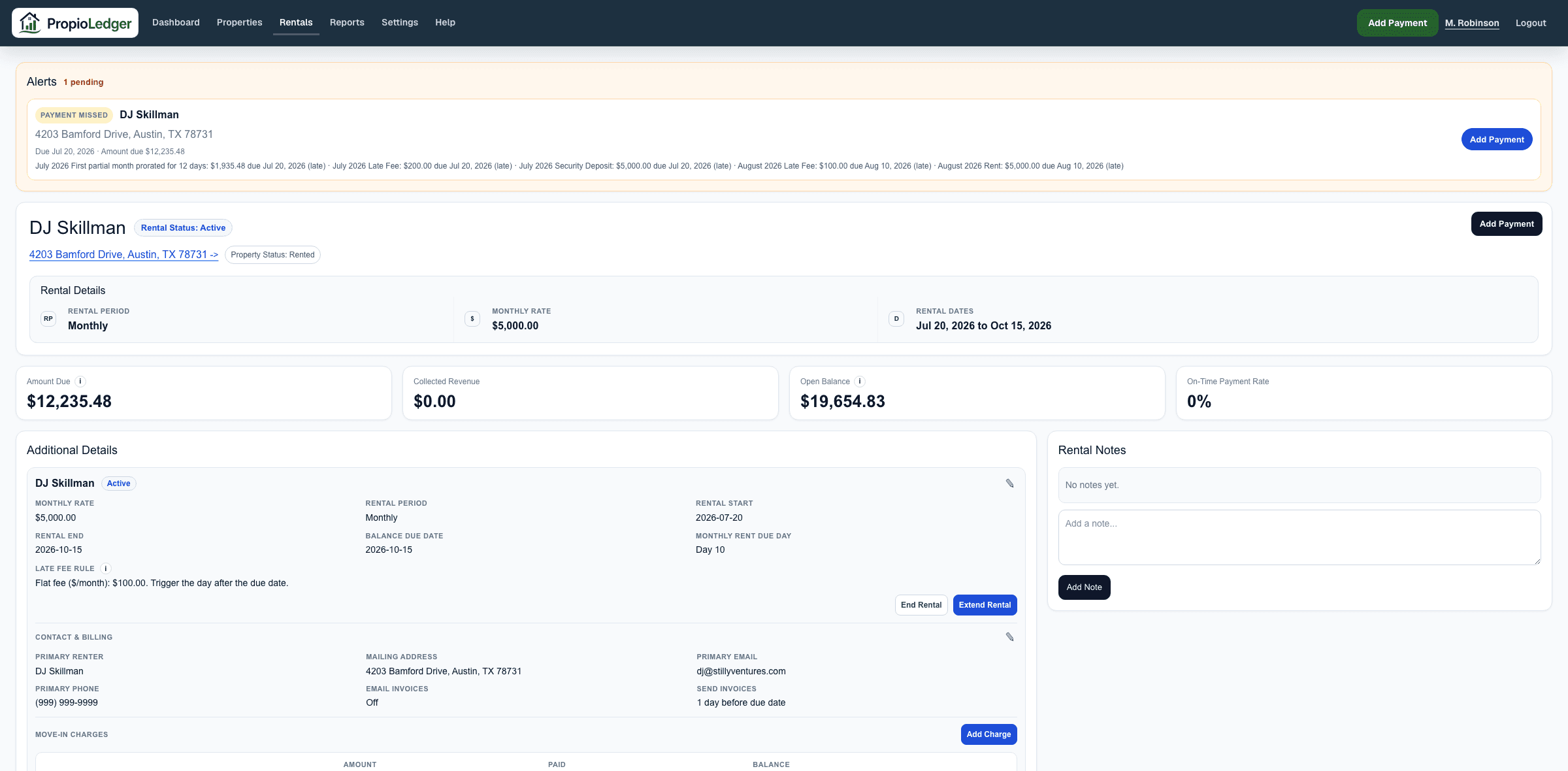
In PropioLedger, rental detail pages include rental-scoped audit history so users can review setting changes, waivers, waiver reversals, due-date changes, payment voids, reasons, users, and balance impact context tied to that rental.
Open Balance vs. Past Due
Open balance and past due balance are related, but they are not the same thing. An open balance is any amount still unpaid. A past due balance is an unpaid amount whose due date has arrived or passed.
For example, a March rent charge may create an open balance when it appears in the ledger, but it may not become past due until the lease-defined due date arrives. Grace periods and late-fee rules vary by lease and jurisdiction, so landlords should avoid assuming one universal rule.
A useful timeline is: charge created, due date, any applicable grace period, then past due status if the balance remains unpaid.
Related Guides
Open Balance vs. Past DueRental Ledger vs. Bank Statement
A bank statement is important, but it is not a substitute for a rental ledger. A bank statement may show that $1,650 was deposited, but it usually does not explain which tenant paid, which unit the payment belongs to, which rental month it covers, or whether a prior balance remained.
This matters when one deposit includes multiple tenants, a payment covers an older balance, a credit was applied, or a partial payment leaves money unpaid.
| Bank Statement | Rental Ledger |
|---|---|
| Shows money entering or leaving an account | Shows tenant charges, payments, credits, and balances |
| Organized by bank transaction date | Organized by tenant, property, unit, and rental activity |
| May combine multiple payments in one deposit | Identifies individual account activity |
| Does not establish what was owed | Shows both amounts owed and amounts received |
Rental Ledger vs. General Ledger
A rental ledger tracks financial activity associated with a tenant, lease, unit, or property account. It commonly includes rent charged, payments received, late fees, credits, refunds, and balances carried forward.
A general ledger is broader. It is organized around accounting accounts such as cash, rental income, accounts receivable, repairs expense, mortgage interest, owner equity, and liabilities.
A rental ledger answers, "What happened in this tenant or property account?" A general ledger answers, "How did transactions affect the broader accounting records?" PropioLedger focuses on rental property operations, ledger-backed balances, payments, expenses, and rental reporting; it should not be described as full double-entry general-ledger accounting software.
Tenant Ledger vs. Property Ledger
Tenant ledger, rent ledger, and rental ledger are often used interchangeably, but the scope can differ. A tenant ledger focuses on one tenant or lease. A property ledger may look more broadly at the financial activity tied to an entire property.
In a rental system, the tenant ledger helps explain what the tenant owes. Property-level reporting helps the landlord understand income, expenses, cash flow, and performance for the rental property as a whole.
| Tenant Ledger | Property Ledger |
|---|---|
| One tenant or lease | Entire property |
| Primarily charges and payments | Income, expenses, and other property activity |
| Helps track what the tenant owes | Helps evaluate property finances |
| Supports payment-history review | Supports property-level reporting |
Rental Ledger vs. Rent Roll
A rental ledger records detailed transactions over time. A rent roll generally summarizes current lease and rent information across units.
The rental ledger shows charges, payments, balances, and payment history. The rent roll shows units, tenants, monthly rent amounts, occupancy, and lease information. Both can be useful, but they answer different questions.
Related Guides
Rent Roll GuideWhy Landlords Need a Rental Ledger
Rental ledgers help landlords spot missed or partial payments, understand balances carried from earlier months, answer tenant questions, review the sequence of charges and payments, and prepare payment-history records.
They also reduce dependence on memory, text messages, screenshots, and informal notes. For landlords managing several units, consistent ledger records make it easier to review every tenant account the same way.
A well-maintained ledger may be useful supporting documentation in a tenant dispute, accounting review, or attorney conversation, but legal requirements and evidentiary rules vary. A rental ledger should be accurate, consistent, and supported by other records when needed.
- Spot missed, late, or partial rent payments.
- Understand prior balances carried into the current month.
- Answer tenant questions with a clear payment history.
- Maintain more consistent records across multiple properties.
- Identify data-entry errors before they compound.
- Support conversations with a bookkeeper, accountant, property manager, or attorney.
How to Maintain an Accurate Rental Ledger
A rental ledger stays useful only when it is maintained consistently. The best habit is to record activity as it happens instead of reconstructing the account later from bank statements and memory.
In PropioLedger, landlords can create rental records, track rent terms, record payments, review ledger-backed open balances, waive unpaid charges when appropriate, and review payment history. Supporting documents such as leases, bank records, receipts, and notices should be kept in a separate organized system when appropriate because PropioLedger does not store receipt or invoice images.
- Create the tenant, property, unit, and rent terms accurately.
- Record each rent charge under the correct rental period.
- Record payments using the actual payment date.
- Apply partial payments consistently.
- Record lease-authorized fees separately from rent.
- Add credits, waivers, or adjustments with clear context when supported.
- Carry unpaid balances forward instead of overwriting prior activity.
- Review the ledger monthly.
- Correct errors transparently and preserve useful notes where possible.
- Keep supporting records outside PropioLedger when appropriate.
Payment Month vs. Payment Date
Payment date and payment month answer different questions. The payment date is the date money was actually received. The payment month is the rental period to which the payment applies.
For example, a payment received on February 2 may apply to January rent. A payment received on February 28 may apply to March rent if the tenant paid early. Without both values, a tenant account can look current based only on cash received even though the payment actually covered an older balance.
PropioLedger tracks payment month so landlords can distinguish early payments, late payments, and payments applied to prior balances.
| Payment Date | Payment Month | Amount | Meaning |
|---|---|---|---|
| Feb. 2 | January | $1,650 | Late payment of January rent |
| Feb. 28 | March | $1,650 | March rent paid early |
| Mar. 15 | February | $500 | Partial payment toward an older balance |
Handling Partial Payments
A partial payment reduces the balance but does not make the account paid in full. If rent is $1,650 and the tenant pays $1,000, the remaining open balance is $650.
When the next month rent is charged, the prior $650 does not disappear. If a new $1,650 rent charge is added, the total open balance becomes $2,300 before additional payments or credits.
Landlords should avoid marking a month paid merely because some money was received. Acceptance of partial payments can have legal implications in some jurisdictions or situations, so landlords should follow their lease, applicable law, and professional advice.
Handling Late Fees and Other Charges
Fees and other charges should be entered separately from rent so the ledger remains easy to explain. Examples can include late fees, parking fees, utility reimbursements, returned-payment fees, or other lease-authorized service charges.
Not every fee is valid in every jurisdiction or every lease. Landlords should confirm that a fee is permitted by the lease and applicable law, use a clear date and description, and avoid hiding fees inside unexplained balance adjustments.
Correcting Errors Without Losing Clarity
Ledger mistakes happen. A payment may be entered under the wrong date, the wrong payment month, or the wrong amount. A charge may need to be waived or corrected.
When a correction is needed, preserve clarity. Use supported workflows such as editing an incorrect record, deleting a true data-entry mistake, recording a refund, or waiving an unpaid charge where appropriate. Add a note when it helps explain what changed and why.
PropioLedger supports refunds on payment records and waivers for unpaid rent, late-fee, and move-in charge balances. It does not make every historical change immutable, so landlords should be intentional about corrections and keep outside documentation when the reason matters.
Monthly Rental Ledger Checklist
A simple monthly checklist helps keep the ledger current before small issues turn into confusing account histories.
- Confirm the monthly rent charge exists.
- Record every payment received.
- Verify each payment date and payment month.
- Review partial payments.
- Add only valid, lease-authorized fees.
- Review credits, waivers, refunds, or adjustments.
- Verify the open balance.
- Compare the ledger with actual money received.
- Follow up on unexplained discrepancies.
- Review prior balances carried into the month.
Spreadsheet vs. Rental Ledger Software
A spreadsheet can work for one simple rental, especially when there are few payments and no recurring balance issues. As properties, tenants, partial payments, late fees, and reporting needs increase, spreadsheet formulas and separate tabs can become harder to maintain.
Rental ledger software gives landlords a more structured way to connect tenants, properties, charges, payments, payment months, open balances, and reports. The tradeoff is that landlords need to follow the software workflow consistently.
| Consideration | Spreadsheet | Rental Ledger Software |
|---|---|---|
| Initial setup | Flexible but manual | Structured workflow |
| Running balance | Requires formulas | Calculated from entered activity |
| Multiple tenants | Separate sheets or filters | Organized tenant records |
| Payment month | Must be added manually | Can be a dedicated field |
| Partial payments | Requires careful formulas | Reflected in balances |
| Reporting | Custom setup required | Generated from recorded data |
| Error risk | Formulas can be overwritten | More consistent data structure |
Related Guides
Rental Property Accounting Software vs. SpreadsheetsWhat a Rental Ledger Does Not Replace
A rental ledger is one important record within a broader property management and accounting system. It does not replace a signed lease, bank statements, payment receipts, security-deposit records, property accounting records, tax documentation, legal notices, or professional accounting or legal advice.
The strongest recordkeeping system connects the ledger with consistent bookkeeping, property-level reporting, and organized supporting records.
Ready to Organize Your Rental Ledgers?
PropioLedger helps landlords organize rent charges, tenant payments, payment months, open balances, past-due balances, refunds, waivers, and property performance in one rental-focused system.