

Key takeaways
- A rent roll is a snapshot of current rental units, tenants, rent amounts, lease dates, occupancy, deposits, statuses, and balances.
- A rent roll is not a transaction history. Rental ledgers show charges, payments, credits, refunds, waivers, and running balances over time.
- Landlords use rent rolls for monthly reviews, lender requests, property sales, acquisitions, renewal planning, and vacancy monitoring.
- Useful rent rolls include occupied units, vacant units, lease expirations, security deposit information, and balance context where available.
- PropioLedger organizes rental properties, rentals, occupancy, balances, income, reporting, and performance without claiming to replace enterprise accounting software.
On this page
- What Is a Rent Roll?
- Why Rent Rolls Matter
- What Information Is Included In A Rent Roll?
- What a Rent Roll Does NOT Include
- Rent Roll Example
- Who Uses Rent Rolls?
- When Do Lenders Request a Rent Roll?
- How Landlords Use Rent Rolls
- Rent Roll vs Rental Ledger
- Rent Roll vs General Ledger
- Rent Roll vs Rent Schedule
- Rent Roll vs Common Rental Reports
- Common Rent Roll Mistakes
- How Often Should a Rent Roll Be Reviewed?
- Rent Roll Best Practices
- How PropioLedger Helps
- Educational Disclaimer
- Frequently Asked Questions
What Is a Rent Roll?
A rent roll is a rental property report that summarizes the current status of each rentable unit. It usually shows the property, unit, tenant, monthly rent, lease dates, occupancy status, security deposit information, and any balance context the landlord chooses to include.
A rent roll is a snapshot, not a transaction history. It helps a landlord, lender, buyer, property manager, accountant, or reviewer understand what is currently rented, what is vacant, how much scheduled rent is expected, and which leases may need attention.
Rent rolls are commonly requested during financing, refinancing, property sales, portfolio reviews, insurance reviews, accounting conversations, and monthly rental management. They are useful because they put many operating details in one organized view.
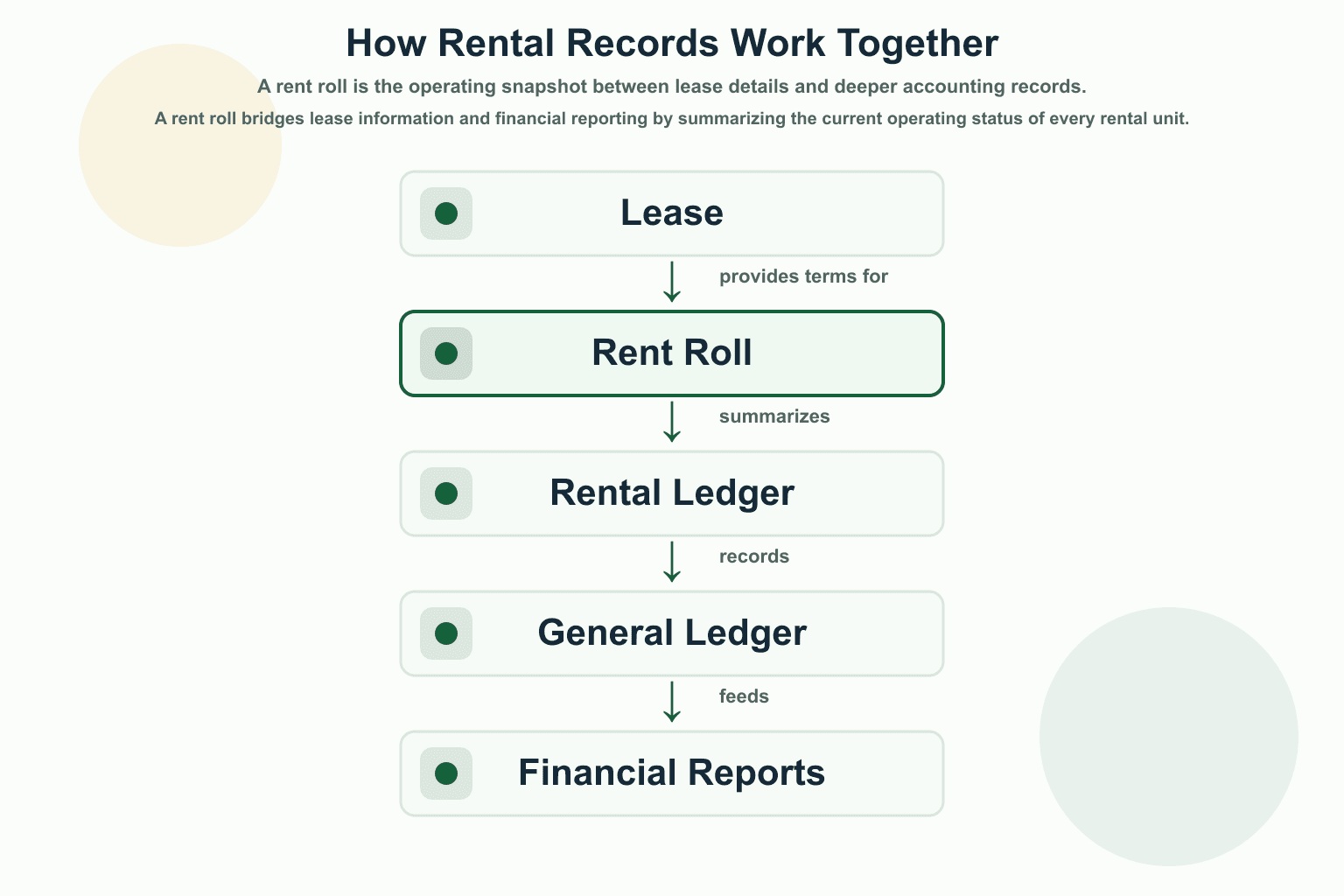
Many first-time landlords confuse a rent roll, rental ledger, general ledger, and rent schedule because each document deals with rental activity. They serve different purposes: a rent roll summarizes current operating status, a rental ledger explains tenant charges and payments, a general ledger organizes accounting activity, and a rent schedule may focus more narrowly on rent amounts or timing.
Why Rent Rolls Matter
A rent roll gives landlords visibility into rental income and occupancy without forcing them to open every lease, payment record, or tenant file. It can show whether scheduled rent is rising, whether units are vacant, whether lease expirations are clustered, and whether balances need follow-up.
For a small landlord, a rent roll can be a monthly operating checklist. For a larger rental portfolio, it can be part of property performance review, financing support, acquisition due diligence, sale preparation, or accountant handoff.
- Income visibility: see scheduled rent by unit and property.
- Occupancy review: identify occupied, vacant, future, late, or inactive units.
- Lease management: monitor lease start dates, end dates, renewals, and move-outs.
- Property performance: compare rent, vacancy, and balances across properties.
- Financing support: provide lenders with a concise operating snapshot when requested.
- Acquisition and sale review: help buyers, sellers, and advisors understand current rental status.
- Portfolio management: review many properties using a consistent format.
What Information Is Included In A Rent Roll?
The exact format varies, but the most useful rent rolls include enough detail to explain each unit without turning the report into a full ledger. The goal is to show current rental status, not every historical charge and payment.
Some rent rolls include balances due, deposit information, renewal notes, market rent, or move-in dates. Others stay narrower and only include unit, tenant, rent, lease dates, and occupancy. Landlords who maintain clean Rental Property Bookkeeping and Rental Property Accounting records can usually review a rent roll alongside income, expense, and property reports with less cleanup.
| Property | Unit | Tenant | Monthly Rent | Lease Start | Lease End | Security Deposit | Occupancy | Status | Balance |
|---|---|---|---|---|---|---|---|---|---|
| Property name or address | Unit identifier | Current renter or vacant | Scheduled recurring rent | Lease or rental start date | Lease or rental end date | Deposit held or expected | Occupied or vacant | Current, late, vacant, ending, or inactive | Optional open or past-due balance |
What a Rent Roll Does NOT Include
A rent roll generally does not include individual payment history, detailed transaction activity, journal entries, expense history, or accounting accounts. Those records belong in other reports and accounting documents.
For example, the rental ledger should explain how tenant balances were created and reduced, the general ledger should explain accounting activity by account, and journal entries explain individual accounting events in formal accounting workflows.
- Individual payment history.
- Transaction details for every charge, credit, waiver, refund, or payment.
- Journal entries.
- Expense history.
- Accounting accounts from a chart of accounts.
Rent Roll Example
The example below is simplified and fictional. It shows how a landlord might review a duplex and a small apartment property in one rent roll report.
Notice that the rent roll includes vacant units and late units. Leaving vacant units out can make occupancy and scheduled income look better than reality.
| Property | Unit | Tenant | Monthly Rent | Lease Start | Lease End | Security Deposit | Occupancy | Status | Balance |
|---|---|---|---|---|---|---|---|---|---|
| Oak Street Duplex | Unit A | Sarah Johnson | $1,750 | Apr. 1, 2026 | Mar. 31, 2027 | $1,750 | Occupied | Current | $0 |
| Oak Street Duplex | Unit B | Vacant | $1,700 | - | - | - | Vacant | Available | - |
| Maple Apartments | Unit 201 | Michael Smith | $2,100 | Jan. 1, 2026 | Dec. 31, 2026 | $2,100 | Occupied | Current | $0 |
| Maple Apartments | Unit 202 | Emily Davis | $2,050 | Jun. 1, 2026 | May 31, 2027 | $2,050 | Occupied | Current | $0 |
| Maple Apartments | Unit 203 | James Wilson | $2,050 | Sep. 1, 2025 | Aug. 31, 2026 | $2,050 | Occupied | Late | Past Due $325 |
| Maple Apartments | Unit 204 | Priya Patel | $2,000 | Mar. 15, 2026 | Mar. 14, 2027 | $2,000 | Occupied | Current | $0 |
Who Uses Rent Rolls?
Rent rolls are useful because they are understandable to many different reviewers. They are detailed enough to show unit-level rental status, but summarized enough to scan quickly.
A landlord may use the report every month. A lender may request it during financing. A buyer may review it during acquisition due diligence. An accountant may use it to understand expected rental income, occupancy, and lease context before reviewing deeper accounting records.
- Landlords and rental property owners.
- Property managers.
- Lenders and banks.
- Buyers and investors.
- Accountants, bookkeepers, and CPA firms.
- Insurance providers when rental status or occupancy information is relevant.
When Do Lenders Request a Rent Roll?
Lenders often request a rent roll report when they need to understand rental income, occupancy, lease status, and unit-level operating details before making or reviewing a loan decision.
A lender may ask for a property rent roll during purchase financing, refinance review, commercial lending, portfolio lending, investment property underwriting, or due diligence. For larger properties, the request may be described as a multifamily rent roll, apartment rent roll, or commercial rent roll depending on the property type and lending context.
Lenders often compare the rent roll against leases, income records, bank activity, rental ledgers, cash flow reports, and other financial reports. Differences do not always mean something is wrong, but they usually need to be explained clearly.
- Purchase financing for a rental property acquisition.
- Refinancing an existing rental property loan.
- Commercial lending or portfolio lending review.
- Investment property underwriting.
- Buyer, lender, or advisor due diligence.
How Landlords Use Rent Rolls
The most practical rent roll habit is monthly review. A landlord can scan the report to confirm that rent amounts are correct, vacant units are visible, lease expirations are not being missed, deposits are tracked consistently, and balances are not quietly growing.
Rent rolls are also useful before major decisions. If a landlord is preparing for a lender request, buying a property, selling a property, reviewing rent increases, or forecasting vacancies, the rent roll provides a starting point for questions that need deeper records.
- Review rental status at the beginning or end of each month.
- Check occupancy and identify vacant units immediately.
- Prepare information commonly requested by lenders or banks.
- Support buyer or seller review during a property transaction.
- Monitor upcoming lease expirations and renewal needs.
- Review rent increases, market rent gaps, and scheduled rental income.
- Forecast vacancies and leasing workload.
- Compare properties in a rental portfolio using consistent unit-level details.
Rent Roll vs Rental Ledger
A rent roll and a rental ledger both help landlords understand rental activity, but they answer different questions. A rent roll is a current snapshot of units, tenants, rents, lease dates, occupancy, and statuses. A rental ledger is a transaction history of charges, payments, credits, refunds, waivers, and balances over time.
For a more detailed comparison of rental ledgers, tenant ledgers, payment history, and accounting records, see our Rental Ledger Guide.
| Topic | Rent Roll | Rental Ledger |
|---|---|---|
| Purpose | Current operating snapshot | Detailed account history |
| Timeframe | Point-in-time status | Chronological history over time |
| Payments | May show balance status only | Shows payment dates, amounts, and application |
| Balances | May include current or past-due balance | Shows how the balance was created and reduced |
| Lease dates | Commonly included | May appear as context but not the main purpose |
| Charges | Usually summarized or omitted | Shows rent, fees, credits, waivers, refunds, and adjustments |
| Updates | Reviewed regularly for current accuracy | Updated when transactions or corrections occur |
Related Guides
Rental Ledger ExplainedRent Roll vs General Ledger
A general ledger is an accounting record organized by accounts such as rental income, repairs, insurance, utilities, owner contributions, assets, liabilities, and equity. A rent roll is an operational report organized by properties and rentable units.
The rent roll answers questions such as which units are occupied, what rent is scheduled, and when leases expire. The general ledger answers accounting questions about how transactions were classified and summarized.
Both records can be useful, but they should not be treated as interchangeable. A Chart of Accounts gives the general ledger its account structure, while Journal Entries explain individual accounting events before they become part of accounting history.
Rent Roll vs Rent Schedule
Rent schedule can mean different things depending on context. In everyday rental operations, it may refer to a list of scheduled rent amounts by unit or a lease schedule showing when rent is due. In commercial real estate or financing conversations, it may be used similarly to rent roll or as a supporting schedule.
A rent roll is usually broader because it includes operating context such as tenant, unit, lease dates, occupancy, status, deposits, and sometimes balances. A rent schedule may focus more narrowly on rent amounts and timing.
Because the terms can overlap, landlords should confirm what a lender, buyer, accountant, or advisor wants before sending a report.
Rent Roll vs Common Rental Reports
A rent roll is most useful when it is reviewed with other rental reports. Each report answers a different question, so landlords should avoid expecting one document to replace every operating or accounting view.
| Report | Primary Purpose | Best For |
|---|---|---|
| Rent Roll | Current snapshot of units, tenants, rent, lease dates, occupancy, status, deposits, and balances | Monthly operating review, lender requests, acquisitions, sales, and lease management |
| Rental Ledger | Chronological record of charges, payments, credits, refunds, waivers, and balances | Payment history, open balances, past-due review, and renter account questions |
| General Ledger | Accounting record organized by financial accounts | Accounting review, classification, transaction history, and financial reporting support |
| Cashflow Report | Summary of rental income, expenses, and cash movement over a period | Understanding whether properties are producing spendable cash |
| Performance Report | Property-level comparison of income, expenses, cash flow, occupancy, and profitability | Comparing rental properties and spotting portfolio trends |
| Open Balance Report | List of unpaid balances that remain open | Following up on unpaid charges and reviewing amounts owed |
Common Rent Roll Mistakes
Rent roll mistakes often come from treating the report as a one-time document instead of a living operating snapshot. A stale rent roll can misstate scheduled income, hide vacancy, miss lease expirations, or create confusion during financing and sale conversations.
| Mistake | Why It Matters |
|---|---|
| Missing lease dates | Renewals, expirations, and move-outs become harder to manage |
| Incorrect rents | Scheduled income, valuation review, and performance comparisons become unreliable |
| Inactive tenants still listed as active | Occupancy and balance status can be overstated |
| Vacant units omitted | Vacancy and potential rental income are hidden |
| Wrong security deposits | Deposit records may not agree with lease or accounting records |
| Renewals not updated | Lease end dates and rent amounts can become stale |
| Multiple properties combined without structure | Property-level performance becomes harder to review |
How Often Should a Rent Roll Be Reviewed?
Many landlords review the rent roll monthly because rent amounts, occupancy, lease dates, balances, and vacancies can change quickly. A monthly rhythm helps catch small errors before they affect lender requests, property reporting, or owner decisions.
Landlords should also review the rent roll before financing or refinancing, before tax or accounting meetings, before lease renewals, before listing a property for sale, and before sharing records with a buyer, lender, accountant, or advisor.
Rent Roll Best Practices
A rent roll works best when it is maintained consistently and reviewed with other records. It should be easy to scan, but it should also connect back to leases, rental ledgers, payment history, deposit records, and property-level reports when deeper review is needed.
A rent roll does not replace good bookkeeping. It complements accounting records, rental ledgers, payment history, and financial reports by giving landlords a quick operating snapshot.
- Review the rent roll at least monthly.
- Verify scheduled rent amounts against the current lease or rental agreement.
- Track lease renewals and upcoming end dates before they become urgent.
- Update vacancies immediately when a rental ends or a unit becomes available.
- Keep each property and unit consistently named.
- Review balances alongside rental ledger detail.
- Track security deposits separately from rental income.
- Avoid combining unrelated properties in a way that hides property-level performance.
- Keep supporting leases, notices, deposit records, and accounting documents organized outside the rent roll.
How PropioLedger Helps
PropioLedger helps landlords organize the rental records that make rent-roll-style review easier: properties, rentals, rent terms, occupancy, renter balances, income, property expenses, reporting, and performance.
The app is rental-specific. It tracks rental agreements, renters, payments, open balances, past-due balances, property expenses, cash flow, occupancy, income, and property profitability so landlords can review their portfolio with clearer context and connect rent-roll-style review to financial reports.
PropioLedger should not be described as enterprise property management software or full general accounting software. It is built to give landlords and small rental property owners a more structured system for rental operations, ledger-backed balances, financial visibility, and reporting.
Keep Your Rental Portfolio Organized
Track rent rolls, occupancy, renter balances, cash flow, and property performance in one rental-focused workflow.
Educational Disclaimer
This guide is for general educational purposes and is not tax, accounting, legal, or financial advice. Landlords should consult a qualified professional for guidance specific to their situation.