

Key takeaways
- Ordinary and necessary expenses associated with operating, managing, conserving, or maintaining rental property may generally be deductible, subject to applicable rules.
- Mortgage principal is not a rental expense; mortgage interest may generally be deductible to the extent properly allocable to rental activity.
- Repairs and maintenance may qualify for current deduction, while qualifying improvements generally must be capitalized unless an applicable rule or safe harbor changes the treatment.
- Rental buildings, improvements, and other qualifying assets may generate depreciation deductions rather than immediate expense deductions.
- Good property-level records make it easier to separate rental expenses, personal costs, capital improvements, and amounts that require professional review.
On this page
- What Landlords Should Know About Rental Property Tax Deductions
- Why Good Bookkeeping Matters More Than Tax Season
- Understanding Rental Property Tax Deductions
- Common Rental Property Tax Deduction Categories
- Mortgage Interest
- Property Taxes
- Insurance Premiums
- Repairs, Maintenance, and Improvements
- Rental Property Depreciation
- Utilities
- Professional Services
- Advertising And Marketing
- Auto and Travel Expenses
- Property Management Fees and Commissions
- Software, Bank Fees, and Office Expenses
- Personal Use and Mixed-Use Rental Property
- Expenses Before a Property Is Rented
- Security Deposits and Rental Income
- Expenses Landlords Commonly Misclassify
- Keep Your Financial Records Organized
- Preparing for Schedule E
- Rental Losses and Deduction Limits
- Year-End Bookkeeping Checklist
- How PropioLedger Helps
- Authoritative References
- Educational Disclaimer
- Frequently Asked Questions
What Landlords Should Know About Rental Property Tax Deductions
Tax preparation starts with records that distinguish potential current rental expenses, capital costs, and personal expenses. Deduction availability and timing can also depend on rental versus personal use, accounting method, passive activity rules, at-risk rules, when the property became available for rent, and other taxpayer-specific circumstances.
This guide introduces common U.S. federal tax concepts and the records landlords can organize for professional review. It does not determine an individual deduction or replace tax advice. Detailed depreciation calculations belong in the separate Rental Property Depreciation Guide.
Why Good Bookkeeping Matters More Than Tax Season
Many landlords think about taxes once a year. Well-run rental businesses think about records every month.
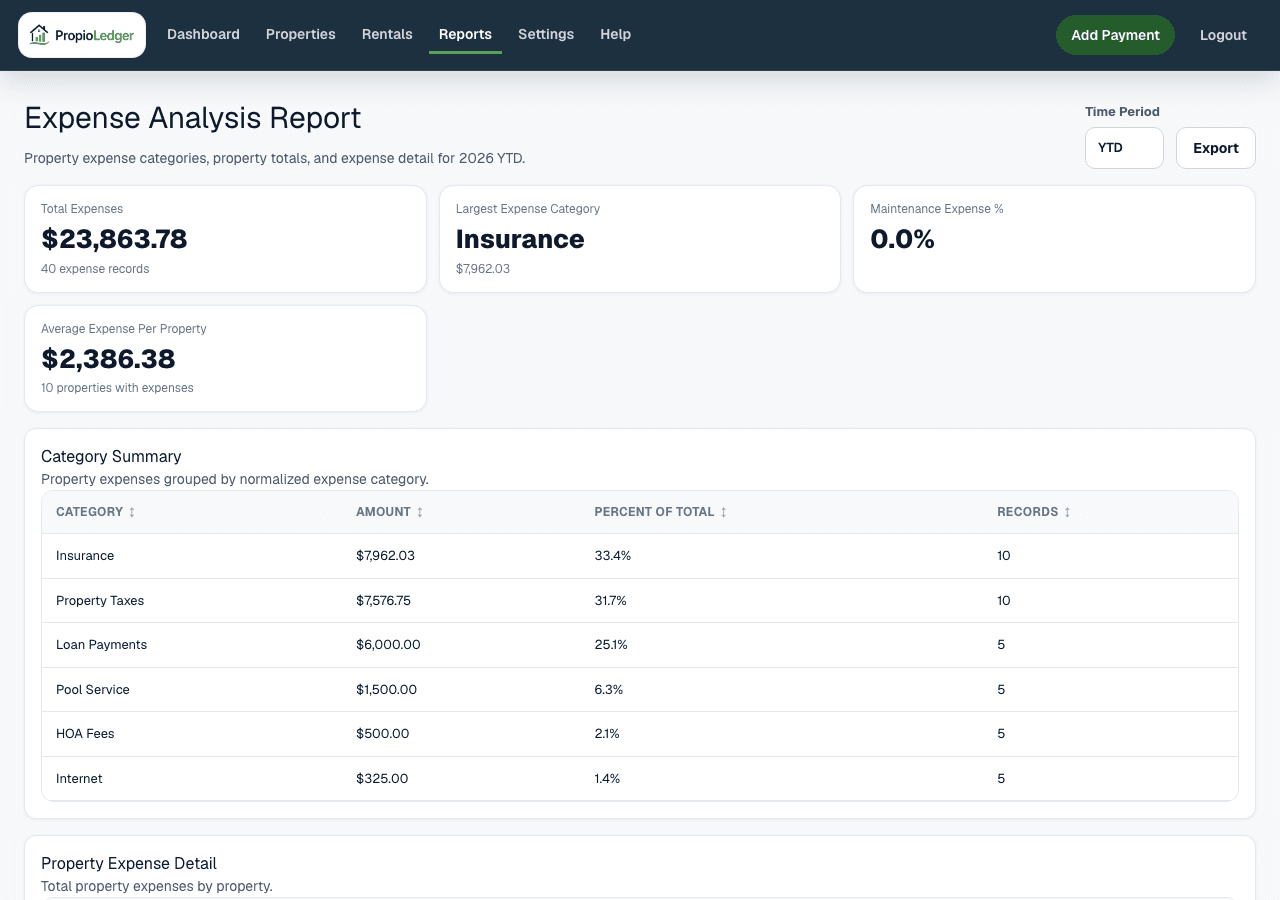
When every transaction is recorded and categorized as it occurs, monthly cash flow reports become more accurate, property profitability is easier to measure, year-end tax preparation becomes simpler, and your CPA or tax preparer has cleaner records to review.
Good bookkeeping is not only about filing taxes. It gives landlords a clearer picture of how each rental property is actually performing.
Understanding Rental Property Tax Deductions
Rental property tax deductions are qualifying costs that may reduce taxable rental income under the applicable rules. In general, expenses that are both ordinary and necessary for operating, managing, conserving, or maintaining a rental property may be deductible.
An ordinary expense is common and accepted in rental property activity. A necessary expense is helpful and appropriate for operating or managing the rental property.
Ordinary and necessary expenses for managing, conserving, or maintaining rental property may generally begin to qualify when the property is made available for rent, subject to applicable rules. That does not make every acquisition cost or pre-rental renovation an immediate deduction.
The table below separates the initial tax questions. An expense’s date, purpose, rental allocation, and potential capitalization treatment matter alongside its bookkeeping category.
| Cost / Activity | Typical Tax Question |
|---|---|
| Mortgage interest | Potential rental expense, subject to allocation and applicable rules |
| Mortgage principal | Generally not a rental expense |
| Routine operating expense | Potential current rental expense |
| Repair / maintenance | Potential current expense depending on facts |
| Capital improvement | Generally capitalized unless applicable rules or safe harbors change treatment |
| Depreciable property | Cost recovery over applicable period |
| Land | Generally not depreciable |
| Personal expense | Generally not a rental deduction |
Actual treatment depends on the facts and applicable tax rules.
Common Rental Property Tax Deduction Categories
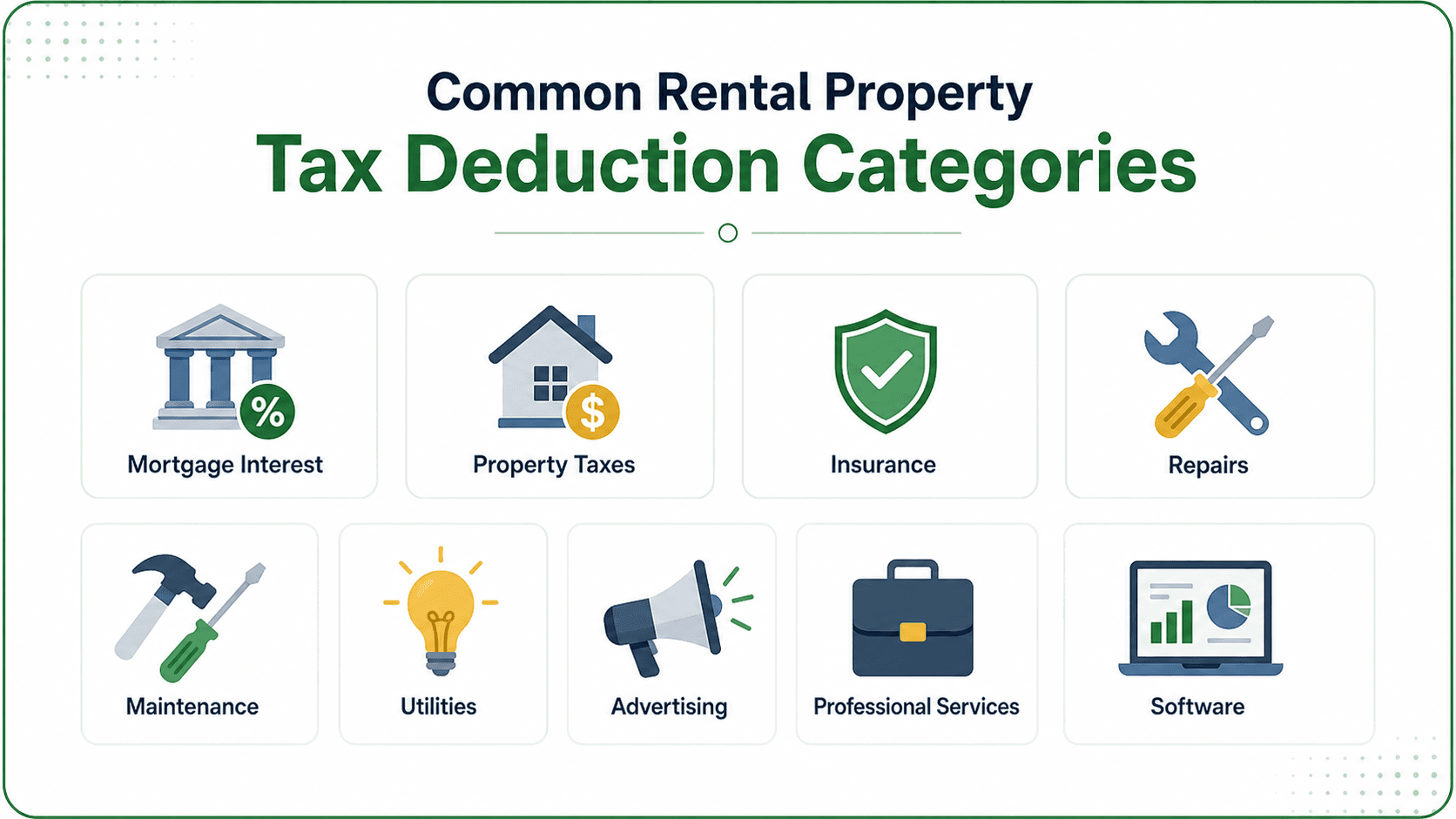
Landlords commonly review several recurring expense categories during tax season. Deductibility depends on the facts, current tax rules, and accountant classification, but the categories below are common starting points for organized rental bookkeeping.
Mortgage Interest
For many landlords, mortgage interest is one of the largest expenses associated with owning rental property. Interest generally must be properly allocable to the rental activity to qualify as a rental expense, subject to applicable limitations.
The interest portion and principal portion serve different purposes. Mortgage principal is not a rental operating expense; it reduces debt and can build equity. The Rental Property Equity Guide explains how loan balances relate to estimated ownership equity.
Debt-proceeds tracing rules can matter. Interest is not a rental deduction merely because the debt is secured by a rental property: how the borrowed money was used can determine its allocation. Keep records of the use of loan proceeds, particularly when refinancing or borrowing for several purposes.
If a mortgage payment includes escrow for taxes and insurance, review those amounts separately from interest when the taxes or insurance are actually paid on your behalf. Do not treat the entire mortgage payment as a deductible expense.
IRS interest allocation guidance
IRS Schedule E InstructionsProperty Taxes
Property taxes assessed by state or local governments are commonly reviewed as rental property expenses. Examples may include county property taxes, city property taxes, and school district taxes properly attributable to rental activity.
Not every government assessment is necessarily currently deductible. Charges for local improvements that increase property value, such as new streets or utility systems, can require capitalization. Ordinary property taxes and assessments for maintenance, repairs, or related interest can have different treatment.
Many lenders collect property taxes through escrow. Even then, keep property taxes separate from mortgage interest and retain the tax statements so your preparer can review what was assessed and paid.
IRS property tax guidance
IRS Publication 527 — Residential Rental PropertyRepairs, Maintenance, and Improvements
Tax classification depends on the nature and extent of the work, not simply what the invoice calls it. A contractor’s “repair” description does not by itself establish a current deduction, and the same type of work can have different treatment depending on its scope and circumstances.
Repair and maintenance costs may potentially be currently deductible. Examples for review include fixing an existing leak, servicing HVAC equipment, pest control, or routine lawn care. Qualifying improvements generally must be capitalized. For buildings, the relevant building structure or system matters when applying the IRS improvement framework.
The routine maintenance safe harbor, safe harbor for qualifying small taxpayers, and de minimis safe harbor may affect treatment when their conditions are met. Applicable elections can also matter. These rules are not automatic exemptions for every small invoice or regularly scheduled project; have a professional assess which rules apply.
If a project must be capitalized rather than deducted currently, see the Rental Property Depreciation Guide for an explanation of basis, placed-in-service dates, recovery periods, and depreciation.
- Betterment: for example, correcting a material pre-existing defect or materially increasing capacity or quality.
- Restoration: for example, replacing a major component or substantial structural part of the relevant property.
- Adaptation: changing the property to a new or different use inconsistent with its intended ordinary use when originally placed in service.
IRS repairs and improvements guidance
IRS Tangible Property Regulations guidanceRental Property Depreciation
Depreciation generally allows the cost or other basis of qualifying property to be recovered over time. Land generally is not depreciable. Qualifying residential rental buildings generally use a 27.5-year recovery period under the General Depreciation System (GDS), while different assets may have different recovery periods.
Depreciation generally begins when qualifying property is placed in service—ready and available for its intended rental use. The applicable method and convention affect the deduction. See the Rental Property Depreciation Guide for the detailed explanation; this overview does not establish a depreciation schedule.
IRS depreciation guidance
IRS Publication 527 — Residential Rental PropertyIRS Publication 946 — How To Depreciate PropertyUtilities
If the property owner pays utilities, those costs are commonly tracked as rental operating expenses. Examples include electricity, water, sewer, trash collection, natural gas, internet, and other owner-paid utility services.
If a renter pays an expense that is legally the landlord’s obligation under the lease and deducts it from rent, the amount generally must be included in rental income. The qualifying expense is considered separately. Publication 527 illustrates this with an owner’s water and sewage bill paid by a renter.
Keep records of the expense, who was responsible for it, and how it was paid or reimbursed. A renter’s own utility obligation under a different lease arrangement is not automatically treated the same way.
IRS renter-paid expense guidance
IRS Publication 527 — Residential Rental PropertyProfessional Services
Professional services related to rental property activity may be deductible depending on the service and situation. Common examples include CPA services, tax preparation attributable to rental activity, bookkeeping, property management, and qualifying legal or consulting work.
Not every attorney fee is a current expense. Legal fees related to acquiring property, defending or protecting title, or certain capital matters may require capitalization rather than immediate deduction. Ask for enough detail on the invoice to identify the service’s purpose.
Categorize these costs consistently and separate rental-related services from personal work or capital transactions before year-end review.
IRS professional fee guidance
IRS Publication 527 — Residential Rental PropertyAdvertising And Marketing
Finding renters is part of operating rental property, and advertising costs are commonly tracked separately from other expenses.
Examples include professional photography, listing upgrades, rental listing site fees, social media ads, yard signs, leasing flyers, and virtual tour software.
Tracking advertising separately helps landlords understand the cost of filling vacancies.
Auto and Travel Expenses
Ordinary and necessary auto or travel expenses related to rental activity may potentially be deductible, subject to applicable rules. Examples for review include trips to inspect a rental, perform or coordinate qualifying management activity, or purchase rental-related supplies.
Personal travel does not become a rental deduction merely because the owner checks on a property during the trip. Commuting restrictions can apply to travel between home and a rental property; a rental purpose alone does not make every local trip deductible. Travel primarily for a capital improvement can also require different treatment from ordinary management travel.
Record the date, destination, business or rental purpose, mileage where relevant, and supporting expenses. Separate personal portions and retain the documentation required for the method used. Consult current IRS guidance for the relevant year rather than relying on an old mileage rate.
IRS auto and travel guidance
IRS Publication 527 — Residential Rental PropertyIRS Publication 463 — Travel, Gift, and Car ExpensesProperty Management Fees and Commissions
Qualifying fees paid for managing or leasing rental property are commonly rental expenses. Potential examples include property management fees, leasing commissions, renter placement fees, and other operational service fees attributable to rental activity.
Review the service, contract period, and applicable timing rules. Acquisition-related commissions and other capital transaction costs are not treated identically to routine management fees. Keep itemized statements so different services can be classified separately.
IRS fee classification guidance
IRS Publication 527 — Residential Rental PropertyIRS Schedule E InstructionsSoftware, Bank Fees, and Office Expenses
Ordinary and necessary software or administrative costs used for rental activity may qualify as rental expenses, depending on the facts. Examples for review include bookkeeping or accounting software, property-management software, fees associated with rental bank accounts, and reasonable office or supply costs attributable to rental activity.
Separate personal use and review whether a cost is a current service, prepaid expense, equipment purchase, or another type of capital cost. A PropioLedger subscription is not automatically deductible simply because it is used by a landlord; the applicable rules and rental purpose still govern treatment.
IRS expense reporting guidance
IRS Schedule E InstructionsPersonal Use and Mixed-Use Rental Property
When a dwelling has both rental and personal use, expenses generally must be allocated between those uses under applicable IRS rules. Personal expenses generally are not rental deductions, and a dwelling treated as a home under IRS rules may be subject to additional deduction limitations.
Shared expenses may require a reasonable allocation using the method appropriate to the cost and circumstances. Renting part of a home can also require separating costs for the rental space from shared or personal portions.
Track fair-rental days and personal-use days where applicable, along with records supporting the space or expense allocation. Vacation-home and partial-home rental rules have additional details; Publication 527 and a qualified preparer can help determine the correct treatment.
IRS personal-use guidance
IRS Publication 527 — Residential Rental PropertyIRS Schedule E InstructionsExpenses Before a Property Is Rented
Purchasing or preparing a property is different from having it ready and available for rent. Ordinary and necessary expenses for managing, conserving, or maintaining rental property may generally be deductible from the time it is made available for rent, subject to applicable rules, even if the first renter has not moved in.
Acquisition costs, improvements, and other capital costs can require different treatment. Merely planning to rent a property does not make every preparation cost currently deductible.
Keep the availability date and supporting records. The Rental Property Depreciation Guide explains placed-in-service timing for qualifying assets without treating the purchase date or first rent payment as an automatic substitute.
IRS pre-rental expense guidance
IRS Publication 527 — Residential Rental PropertySecurity Deposits and Rental Income
A refundable security deposit generally is not rental income when received if the landlord intends to return it to the renter. If some or all is retained because the renter did not fulfill the lease, the retained amount generally becomes rental income in that year; review the reason and circumstances.
An amount intended as the final payment of rent is generally advance rent even if it is called a deposit. Keep refundable deposits, rent payments, refunds, and any retained amounts identifiable in the records. This is a federal tax distinction, not guidance on state deposit laws.
IRS guidance and related reading
IRS Publication 527 — Residential Rental PropertyRental Ledger ExplainedExpenses Landlords Commonly Misclassify
These examples identify questions to bring to a tax professional. They are not final classifications for a particular transaction.
| Item | Common Mistake | Better Review Question |
|---|---|---|
| Full mortgage payment | Deducting principal | How much is interest versus principal, and how is the interest allocated? |
| Major renovation | Calling everything a repair | Is the work a betterment, restoration, or adaptation? |
| Land | Depreciating purchase price including land | What portion is attributable to nondepreciable land? |
| Security deposit | Recording every deposit as rental income | Is it refundable or retained under the lease? |
| Personal expense | Putting the entire mixed-use cost into rental expenses | What portion is properly allocable to rental activity? |
| Property improvement | Expensing immediately | Must it be capitalized, or does an applicable safe harbor or election apply? |
| Legal fee | Treating all attorney fees as current expenses | What was the legal service actually for? |
Actual treatment depends on the facts and applicable tax rules.
Keep Your Financial Records Organized
Good bookkeeping is not just about recording numbers. It is about recording enough context that every transaction still makes sense months or even years later.
For each expense, preserve what was purchased, why it related to rental activity, which property it served, and when and how it was paid. An invoice describes the charge; proof of payment supports that it was paid. Both can be useful alongside other required records.
Many landlords keep supporting documents such as invoices and receipts in cloud storage services like Google Drive, OneDrive, Dropbox, or organized computer folders. Use a consistent system so documentation can be found when needed.
Within PropioLedger, the property, vendor, category, date, amount, and notes provide transaction context. Keep supporting receipts and capital-improvement documentation with your separate tax records; this is not a claim that PropioLedger stores receipts or determines capital treatment.
- Receipt or invoice and proof of payment.
- Business or rental purpose and the property involved.
- Vendor, date, amount, and bookkeeping category.
- Notes explaining the cost and any rental/personal allocation.
- A capital-improvement flag in your records or a separate improvement record where relevant, with project and placed-in-service details.
Related Guides
Rental Property Bookkeeping GuidePreparing for Schedule E
Accurate financial records make year-end review easier. Individual taxpayers commonly use Schedule E for rental real estate, depending on the activity and circumstances. Its expense lines provide a tax-reporting framework, but bookkeeping categories and final return classifications are different.
The table below reflects the expense areas in the current IRS Schedule E. It is a review aid, not an automatic mapping of PropioLedger categories. Your preparer may split transactions, reclassify costs, capitalize improvements, or apply taxpayer-specific limitations.
Depreciation comes from the separately maintained tax schedule. See the Rental Property Depreciation Guide for the underlying concepts; PropioLedger does not calculate that deduction or prepare Schedule E.
| Schedule E Expense Area | Bookkeeping Records to Review |
|---|---|
| Advertising | Rental advertising and marketing costs |
| Auto and travel | Rental mileage and travel records, with personal use separated |
| Cleaning and maintenance | Cleaning, maintenance, yard service, pest control, and pool service |
| Commissions | Qualifying leasing commissions and renter placement fees |
| Insurance | Rental insurance and coverage periods |
| Legal and other professional fees | CPA, legal, tax-preparation, and bookkeeping services; capital matters separated |
| Management fees | Qualifying rental management service fees |
| Mortgage interest paid to banks, etc. | Interest statements and support for rental allocation; principal excluded |
| Other interest | Other interest properly allocable to rental activity |
| Repairs | Work reviewed as a current repair rather than an improvement |
| Supplies | Qualifying rental supplies |
| Taxes | Rental property taxes; local-improvement assessments reviewed separately |
| Utilities | Owner-paid electric, gas, water, sewer, trash, internet, and other utilities |
| Depreciation expense or depletion | Separately prepared depreciation schedule and applicable supporting forms |
| Other | Qualifying expenses not reported elsewhere, such as certain bank fees, software, or office costs |
A bookkeeping label does not establish deductibility. Use the form and instructions applicable to your tax year, and avoid counting the same cost in multiple categories.
Official Schedule E resources
IRS Schedule E — Supplemental Income and LossIRS Schedule E InstructionsRental Losses and Deduction Limits
Even when an expense is properly classified as a rental expense, the resulting rental loss may not be fully usable on the current tax return. Classification and the ability to use a loss are separate questions.
Potential limits include passive activity rules, at-risk rules, personal-use limitations, and excess business loss rules where applicable. Their effect depends on the taxpayer and activity. Have a qualified tax professional review current IRS guidance and any prior-year carryovers rather than assuming every properly recorded expense produces an immediate tax benefit.
IRS deduction limitation guidance
IRS Publication 527 — Residential Rental PropertyIRS Schedule E InstructionsYear-End Bookkeeping Checklist
Before tax season, review income, expenses, supporting records, and reports for each property. Compare unusual costs with prior years and resolve missing information while invoices and explanations are still easy to obtain.
- Reconcile rental income with payment records and statements.
- Review renter-paid expenses and reimbursements.
- Review refundable, returned, and retained security deposits.
- Categorize expenses consistently.
- Separate personal costs and mixed-use allocations.
- Separate repairs from projects that may be capital improvements.
- Identify newly placed-in-service assets and improvements.
- Review mortgage interest separately from principal and retain allocation support.
- Reconcile property taxes and insurance with statements and coverage periods.
- Review auto and travel records for purpose, mileage, and supporting expenses.
- Locate invoices, receipts, and proof of payment.
- Review the prior-year depreciation schedule with your preparer.
- Check for duplicate transactions.
- Export annual financial reports for professional review.
How PropioLedger Helps
PropioLedger helps landlords track income and expenses by property, categorize property expenses, monitor monthly cash flow, review property profitability, and generate financial reports. These operating records support both year-end accounting review and decisions during the year.
PropioLedger organizes the operating records that landlords and their accountants can review. Final tax classification remains a tax-preparation decision.
PropioLedger does not determine whether an expense is tax deductible, calculate tax depreciation, prepare Schedule E, or provide tax advice. Keep source documents and depreciation records available for your qualified preparer alongside exported reports.
Explore PropioLedger and related guides
Property FinancialsRental Property Bookkeeping GuideRental Property Depreciation GuideKeep Rental Property Records Ready for Tax Review
PropioLedger helps landlords organize rental income, property expenses, and financial reporting throughout the year so records are easier to review with an accountant or tax professional.
Educational Disclaimer
This guide is for general educational purposes and is not tax, accounting, legal, or financial advice. Landlords should consult a qualified professional for guidance specific to their situation.