
Key takeaways
- A general ledger records transactions inside accounting accounts; a chart of accounts is only the list of categories.
- A rental ledger tracks renter charges, payments, credits, refunds, and balances, while a general ledger is organized around accounting activity.
- Useful ledger records include date, description, account, amount, reference, property, notes, and running balance where applicable.
- Consistent categories and property assignments make reports easier to review and explain later.
- PropioLedger organizes rental income, property expenses, payment activity, renter balances, cash flow, accounting detail, and property performance without claiming to replace full general accounting software.
On this page
- What Is a Rental Property General Ledger?
- Why Landlords Need a General Ledger
- How a General Ledger Works
- What Information Does a General Ledger Contain?
- General Ledger Example
- General Ledger vs Chart of Accounts
- General Ledger vs Rental Ledger
- General Ledger vs Bookkeeping
- General Ledger vs Journal Entries
- How the General Ledger Supports Financial Reports
- Common General Ledger Mistakes
- How PropioLedger Organizes Rental Financial Activity
- Educational Disclaimer
- Frequently Asked Questions
What Is a Rental Property General Ledger?
A rental property general ledger is the complete accounting history of a landlord's financial transactions, organized by financial account rather than by tenant or property. It shows the transactions recorded inside financial accounts such as rental income, repairs, insurance, mortgage interest, utilities, owner contributions, and other categories used by the landlord.
Unlike a chart of accounts, which is the list of available categories, the general ledger contains the actual transaction history inside those categories.
Unlike a rental ledger, which is organized around renters, charges, payments, credits, refunds, and balances, a general ledger is organized around accounting accounts. It answers accounting questions about income, expenses, owner activity, assets, liabilities, and historical financial movement.
For small landlords, the value is practical: a clear ledger makes it easier to explain where money came from, where it went, which property was involved, and how transactions were classified over time.
Why Landlords Need a General Ledger
A landlord may be able to see deposits and withdrawals on a bank statement, but a bank statement alone rarely provides enough accounting context. It usually does not explain whether money was rent, a refundable deposit, an owner contribution, a tenant reimbursement, a repair, a utility bill, mortgage interest, or loan principal.
A general-ledger-style record adds the missing classification. It creates a consistent financial history that can be reviewed month to month and year to year.
The level of detail a landlord needs depends on portfolio size, ownership structure, accounting method, financing, reporting needs, and the professionals reviewing the records.
- Consistent classification of rental income and expenses.
- A chronological history of financial activity.
- Cleaner records for accounting review and tax preparation.
- Better support for property-level reporting.
- A clearer audit trail for unusual transactions.
- Less reliance on memory when reviewing old activity.
How a General Ledger Works
A general ledger works by placing each transaction into the appropriate account. The account explains what type of financial activity occurred, while the transaction details explain when it happened, how much money was involved, who was connected to it, and which property it affected.
Transactions accumulate inside each account over time. If a landlord records five repair expenses during the year, those repair transactions remain visible as individual entries while also contributing to the total repair activity for the reporting period.
In formal accounting workflows, the individual financial event may first be documented as a journal entry and then posted to the general ledger.
In formal accounting systems, general-ledger entries may use debit and credit columns. Small landlords do not always interact directly with debit and credit mechanics, but the concept is still useful: every transaction should be recorded consistently enough that reports can be traced back to the underlying details.
| Step | What Happens |
|---|---|
| Transaction occurs | Rent is received, an expense is paid, owner money is contributed, or another rental-related activity happens |
| Details are recorded | Date, description, amount, property, vendor or renter, and notes are captured |
| Account or category is assigned | The transaction is classified as rent, repairs, utilities, mortgage interest, owner contribution, or another account |
| Ledger history grows | The transaction becomes part of the chronological activity inside that account |
| Reports use the data | Income, expenses, cash flow, profitability, and accounting detail can be reviewed from the organized records |
Related Guides
Rental Property Journal EntriesWhat Information Does a General Ledger Contain?
A useful general ledger contains enough detail that a transaction still makes sense months or years later. The exact fields vary by system, but the purpose is the same: preserve financial context so the record can be reviewed, explained, and summarized.
| Field | Meaning |
|---|---|
| Date | When the transaction occurred or was recorded |
| Description | Plain-language explanation of the activity |
| Account | Financial category affected by the transaction |
| Debit | Formal accounting column used to record one side of an entry |
| Credit | Formal accounting column used to record the other side of an entry |
| Reference | Check number, receipt number, invoice number, payment ID, or other lookup detail |
| Property | Rental property connected to the activity |
| Notes | Extra context such as repair details, tenant name, vendor notes, or adjustment reason |
| Running balance | Updated account balance where that type of account supports one |
General Ledger Example
The example below is simplified and educational. It shows how a landlord might review activity for Oak Street Duplex during one month.
In practice, a formal accounting system may record entries differently depending on accounting method, entity structure, bank accounts, loans, and professional guidance.
This example uses positive amounts for readability. Formal accounting records may display debits and credits or separate inflows and outflows depending on the system.
| Date | Property | Account | Description | Amount |
|---|---|---|---|---|
| Mar 1, 2026 | Oak Street Duplex | Rental Income | Monthly rent received from Unit A renter | $1,550 |
| Mar 5, 2026 | Oak Street Duplex | Insurance | Monthly landlord insurance premium | $175 |
| Mar 10, 2026 | Oak Street Duplex | Repairs | Plumbing repair for leaking kitchen shutoff valve | $185 |
| Mar 15, 2026 | Oak Street Duplex | Mortgage Interest | Interest portion from lender statement | $1,025 |
| Mar 18, 2026 | Oak Street Duplex | Utilities | Owner-paid water and sewer bill | $92 |
| Mar 22, 2026 | Oak Street Duplex | Owner Contribution | Owner transfer to cover property cash shortage | $500 |
General Ledger vs Chart of Accounts
A chart of accounts and a general ledger are closely related, but they are not the same thing.
The chart of accounts is the list of categories available for classification. The general ledger is the transaction history recorded inside those categories.
For example, Repairs may be an account in the chart of accounts. A March 10 plumbing invoice, an April 2 lock repair, and a May 18 HVAC service call are individual ledger transactions inside the Repairs account.
| Chart of Accounts | General Ledger |
|---|---|
| Lists the financial categories used for bookkeeping | Contains transactions recorded inside those categories |
| Defines account names such as Rent, Repairs, Insurance, and Mortgage Interest | Shows dated activity affecting those accounts |
| Provides structure before transactions are recorded | Provides the historical record after transactions are recorded |
| Helps landlords classify activity consistently | Helps landlords review, trace, and summarize activity |
| Usually changes infrequently | Grows every time financial activity is recorded |
General Ledger vs Rental Ledger
The phrase ledger can mean different things in rental property management. A rental ledger and a general ledger both record activity, but they serve different purposes.
A rental ledger is renter-facing or rental-agreement-facing. It tracks charges, payments, credits, waivers, refunds, open balances, and past-due balances for a renter.
A general ledger is accounting-facing. It tracks transactions by financial account, such as income, expenses, assets, liabilities, and owner activity.
| Rental Ledger | General Ledger |
|---|---|
| Organized around renters and rental agreements | Organized around accounting accounts |
| Tracks charges, payments, credits, refunds, waivers, and balances | Tracks income, expenses, owner activity, assets, and liabilities |
| Answers what a renter owes or has paid | Answers how financial activity was classified |
| Supports open balance and past-due review | Supports accounting review and financial reporting |
| Useful for renter account history | Useful for bookkeeping and financial history |
General Ledger vs Bookkeeping
Bookkeeping is the ongoing process of recording, categorizing, reviewing, and organizing financial activity. A general ledger is one of the organized records produced by that process.
Put another way, bookkeeping is the work. The general ledger is part of the resulting financial history.
If a landlord records rent payments, categorizes repairs, reviews utilities, separates security deposits from income, and keeps property expenses assigned to the correct rental, those bookkeeping habits create cleaner ledger-style records and more useful reports.
General Ledger vs Journal Entries
Journal entries record individual accounting events. In a formal accounting workflow, those entries are posted into the general ledger, where they become part of the historical accounting record.
Financial reports then summarize information from the general ledger. This relationship is useful for landlords to understand even when they are not personally creating formal journal entries.
This is an accounting concept, not a statement that PropioLedger currently creates automated journal entries. PropioLedger organizes rental income, property expenses, payment activity, renter balances, accounting detail, cash flow, property profitability, and reports using structured rental records.
Related Guides
Rental Property Journal EntriesHow the General Ledger Supports Financial Reports
Financial reports are only as reliable as the underlying records. When income, expenses, payments, and adjustments are recorded consistently, reports become easier to read and explain.
A general ledger does not magically create good reporting from unclear transaction data. It supports reporting by preserving the classification and transaction detail that reports summarize.
Profit and loss concepts
Income and expense activity can be grouped to show how rental operations performed during a period. Landlords should be careful to distinguish operating results from loan principal, owner transfers, and other non-operating activity.
Cash flow
Cash-flow review focuses on money received and money paid. It may include cash movements, such as debt service, that are different from operating income or tax treatment.
Expense reports
Expense reports use categorized transaction records to show where money was spent by category, property, vendor, or period.
Property performance
Property-level transaction detail helps landlords compare rentals, identify high-cost properties, and understand whether income is covering realistic expenses.
Accounting reports
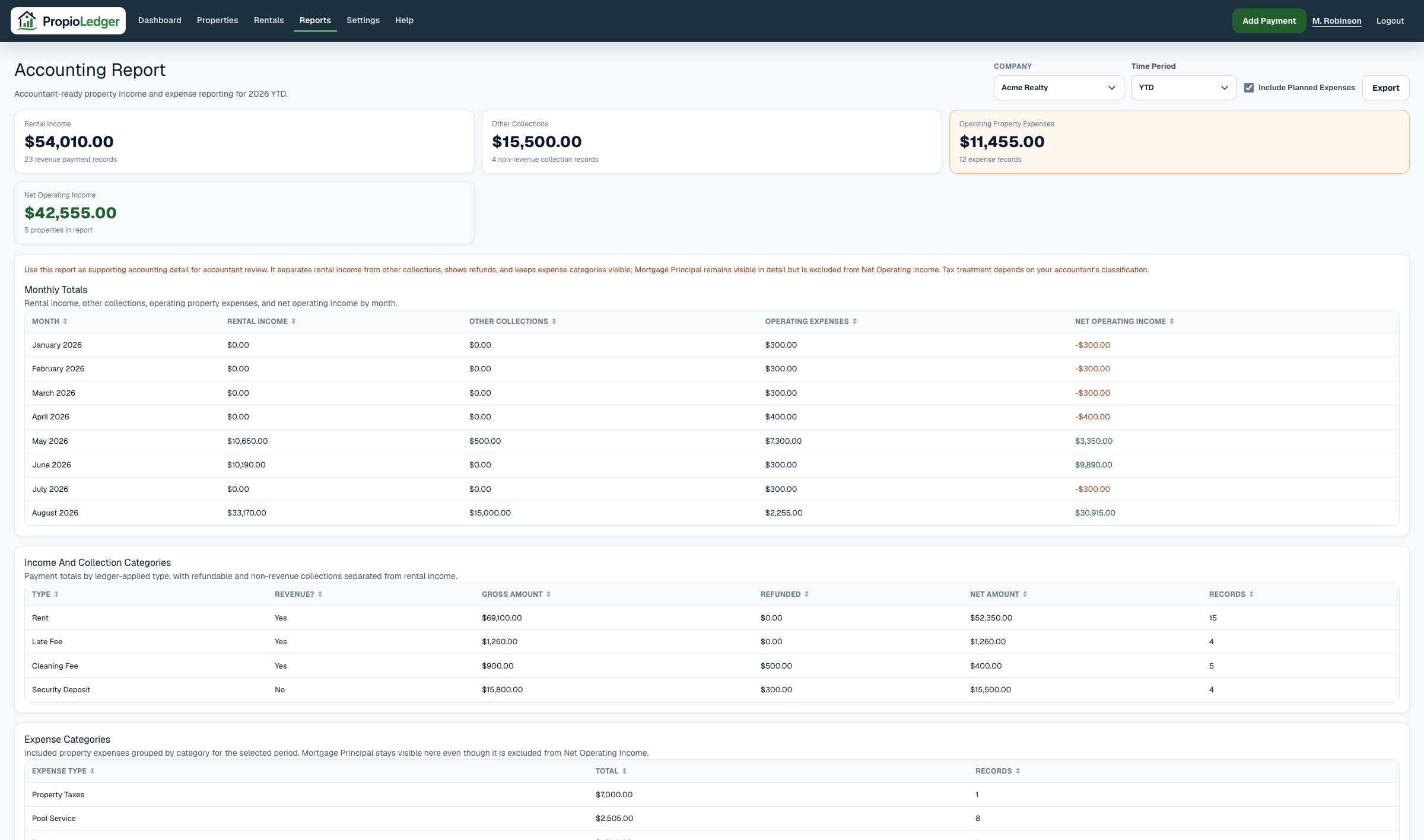
Accounting detail helps landlords and their advisors review income, other collections, expenses, net operating income, and supporting transaction records. This is different from claiming every formal financial statement is produced automatically.
Common General Ledger Mistakes
General-ledger problems usually begin as small bookkeeping shortcuts. The records may look acceptable during the month, but become difficult to use when a landlord tries to review property performance, answer a CPA question, or prepare year-end records.
| Mistake | Better Approach |
|---|---|
| Mixing personal and rental expenses | Keep rental activity separate and identify owner-paid expenses clearly |
| Changing account names during the year | Use stable categories from month to month |
| Using Miscellaneous too often | Create meaningful categories for recurring or important activity |
| Not recording adjustments | Document waivers, refunds, corrections, deposit applications, and other changes |
| Using inconsistent categories | Classify similar transactions the same way each time |
| Missing descriptions | Add plain-language notes that explain what happened and why |
| Ignoring property assignment | Attach transactions to the correct property whenever property-level reporting matters |
| Treating deposits as rent | Keep refundable security deposit activity separate from earned rental income |
| Treating mortgage principal as an operating expense | Separate known principal from mortgage interest when detail is available |
How PropioLedger Organizes Rental Financial Activity
PropioLedger is designed around rental operations and rental-specific financial records. It helps landlords organize rental income, property expenses, payment activity, renter balances, accounting detail, cash flow, property profitability, and reporting.
That structure supports many of the practical reasons landlords care about ledger-style records: transactions can be tied to properties, payment activity can be reviewed, expense categories can be analyzed, renter balances can be traced to ledger activity, and reports can be reviewed without rebuilding the year from scattered spreadsheets.
PropioLedger should not be described as a full general-ledger accounting system, a double-entry accounting platform, or a replacement for every formal accounting workflow. Landlords who need trial balances, formal balance sheets, depreciation schedules, automated bank feeds, bank reconciliation, or complete entity-level accounting should work with a qualified professional and the appropriate accounting tools.
Used carefully, PropioLedger can still give rental property owners a cleaner operating record: income, expenses, payments, balances, cash flow, and property performance remain connected to the rental activity they are trying to manage.
Organize Rental Financial Activity With Confidence
Keeping rental transactions organized is easier when income, expenses, payment activity, renter balances, and property performance stay connected in one rental-specific workflow.
Educational Disclaimer
This guide is for general educational purposes and is not tax, accounting, legal, or financial advice. Accounting records and reporting requirements vary based on ownership, entity structure, accounting method, location, and individual circumstances. Landlords should consult a qualified professional for guidance specific to their situation.