
Key takeaways
- A chart of accounts gives every rental transaction a consistent financial category.
- Rental income, operating expenses, mortgage principal, security deposits, and owner activity should not all be treated the same way.
- Categories should be detailed enough to support useful reporting but simple enough to use consistently.
- Property-level records make it easier to compare rentals and identify unusual costs.
- A chart of accounts is the organizational structure behind bookkeeping; it is not itself a financial report.
On this page
- What Is a Rental Property Chart of Accounts?
- Why Landlords Need a Chart of Accounts
- The Main Account Groups
- Rental Income Categories
- Rental Property Expense Categories
- Mortgage Principal, Interest, Taxes, and Insurance
- Security Deposits
- Owner Contributions, Draws, and Reimbursements
- Assets, Liabilities, and Equity
- Organizing Accounts by Property
- Sample Rental Property Chart of Accounts
- How Detailed Should the Categories Be?
- Common Chart of Accounts Mistakes
- How a Chart of Accounts Connects to Reports
- Chart of Accounts vs. Expense Categories
- How PropioLedger Organizes Rental Financial Activity
- Educational Disclaimer
- Frequently Asked Questions
What Is a Rental Property Chart of Accounts?
A rental property chart of accounts is the master list of financial categories used to record a landlord’s income, expenses, assets, liabilities, and owner activity. It creates the structure behind consistent bookkeeping, understandable property reports, and cleaner year-end records.
This guide is designed for U.S. landlords and rental property owners who want a practical system without turning their bookkeeping into an unnecessarily complicated accounting project.
Each category represents a particular type of income, expense, asset, liability, or owner-related activity.
For a rental property owner, the chart of accounts answers a basic question every time money moves: what kind of financial activity was this?
In traditional accounting, the chart of accounts provides the categories, journal entries document individual financial events using those categories, and the general ledger becomes the account-by-account history built from those records.
A rent payment may be categorized as rental income. A plumbing invoice may be categorized as repairs. A refundable security deposit may be tracked as a liability rather than earned income. The principal portion of a mortgage payment may reduce a loan balance rather than reduce operating income.
Small landlords do not always need the extensive account structures used by large property management companies. A practical rental property chart of accounts should make transactions easy to classify, reports easy to understand, and records easy to review later.
Why Landlords Need a Chart of Accounts
Without consistent categories, the same type of transaction may be recorded differently throughout the year. One plumbing visit might be classified as Repairs, another as Maintenance, and another as Other. When the landlord later reviews annual spending, the records no longer tell a clear story.
A bank statement shows that money entered or left an account. It usually does not explain which property was involved, whether a payment was rent or a deposit, whether an expense was a repair or improvement, or whether money came from a tenant or the owner.
The chart of accounts provides that missing context.
- Record similar transactions consistently.
- Separate rental income from deposits and owner funding.
- Compare expense categories over time.
- Review performance by property.
- Identify unusually high operating costs.
- Prepare cleaner records for accounting and tax review.
- Produce more understandable financial reports.
- Avoid relying only on bank statement descriptions.
The Main Account Groups
A traditional chart of accounts is commonly organized into five broad groups. Many small landlords primarily interact with income and expense categories during monthly bookkeeping. Assets, liabilities, and equity become more important when maintaining complete accounting records or preparing formal financial statements.
The appropriate level of accounting detail depends on the landlord’s portfolio, entity structure, reporting needs, and the requirements of the professionals reviewing the records.
| Account Group | What It Represents | Rental Property Examples |
|---|---|---|
| Assets | Resources the rental business owns or controls | Bank accounts, security deposit funds held, buildings, land, appliances, accumulated depreciation |
| Liabilities | Amounts the rental business owes or may have to return | Mortgage balances, unpaid bills, refundable security deposits |
| Equity | The owner’s financial interest in the rental activity | Owner contributions, owner draws, retained earnings or accumulated results |
| Income | Money earned from rental operations | Rent, late fees, parking income, pet-related income, tenant reimbursements |
| Expenses | Costs incurred to operate and maintain rentals | Repairs, insurance, property taxes, utilities, HOA fees, management fees |
Rental Income Categories
Rental income should be divided into categories that explain how the revenue was earned. A single category called Income may be easy to use, but it provides very little insight.
Do not create categories merely because a payment description is different. Categories should represent financially meaningful distinctions.
For example, rent from Unit A and rent from Unit B do not necessarily require separate income categories if every transaction is already assigned to the correct property or rental agreement. The property assignment explains where the income came from, while the income category explains what kind of income it was.
Refundable security deposits are generally not treated as earned rental income when received if the landlord expects to return them. State and local requirements may also govern how deposit funds must be held and documented.
- Monthly rent
- Nightly rental income
- Late fees
- Pet rent or pet fees
- Parking income
- Storage income
- Laundry income
- Utility reimbursements
- Cleaning fees
- Lease termination fees
- Application or administrative fees when applicable
- Other rental income
Rental Property Expense Categories
Expense categories should explain the actual cost of operating, maintaining, and administering rental property.
Avoid using Other or Miscellaneous as the default for transactions that could be placed in a meaningful category. A small number of transactions in Other may be reasonable. A large annual balance in Other usually indicates that the account structure or bookkeeping process needs improvement.
Repairs and capital improvements should remain distinguishable because they may be treated differently for accounting and tax purposes. Significant projects should be reviewed with a qualified professional.
| Category | Example Transactions |
|---|---|
| Repairs | Fixing a leaking faucet, replacing a broken lock, repairing part of an HVAC system |
| Maintenance | Routine servicing, filter replacement, preventive upkeep |
| Insurance | Landlord insurance, liability coverage, umbrella coverage allocated to rentals when appropriate |
| Property Taxes | Real estate taxes assessed on the rental property |
| HOA Fees | Recurring homeowners association dues and assessments |
| Utilities | Owner-paid water, sewer, gas, electricity, or trash service |
| Yard and Exterior Service | Lawn care, landscaping, tree trimming, snow removal |
| Cleaning | Turnover cleaning, common-area cleaning, recurring cleaning service |
| Pest Control | Routine or one-time pest treatments |
| Management Fees | Property management charges and leasing management fees |
| Professional Fees | Accounting, legal, bookkeeping, and consulting costs related to the rental activity |
| Supplies | Small property supplies and consumable materials |
| Appliances | Appliance purchases, repairs, or replacements, subject to appropriate accounting treatment |
| Improvements | Work that improves, replaces, or materially extends the useful life of the property |
| Advertising and Leasing | Rental listing fees, signs, photography, and leasing costs |
| Other | Uncommon costs that do not fit another established category |
Mortgage Principal, Interest, Taxes, and Insurance
A mortgage payment may contain several components that should not automatically be treated as one operating expense.
For a simple cash-flow view, a landlord may want to see the full mortgage payment as money leaving the property. For accounting and tax review, however, the underlying components may need to be separated.
PropioLedger does not currently calculate or automatically split mortgage principal, interest, taxes, and insurance. A landlord may record the full payment as Loan Payments for a simple cash-flow view or use known statement amounts to record Mortgage Interest, Mortgage Principal, Property Taxes, and Insurance separately when that detail is available.
Mortgage Principal should remain visible for cash-flow purposes without being treated as an operating expense that reduces net operating income.
| Component | Financial Meaning | Practical Treatment |
|---|---|---|
| Mortgage interest | Cost of borrowing | Commonly tracked as an expense using statement detail |
| Mortgage principal | Reduction of the loan balance | Generally reduces a liability rather than operating income |
| Property taxes | Cost imposed on the property | Tracked separately as a property expense |
| Insurance | Cost of property coverage | Tracked separately as a property expense |
| Escrow deposit or activity | Funds collected or disbursed for taxes and insurance | Reconciled using mortgage and escrow statements |
Security Deposits
A refundable security deposit creates a possible future obligation to the renter. For that reason, it should generally remain separate from earned rent when received.
The bookkeeping treatment should preserve the distinction between money being held for possible return, amounts properly applied to unpaid charges or damages, amounts refunded to the renter, and amounts that become income under the applicable facts and rules.
Security deposit laws vary by state and locality. Landlords should follow the handling, notice, documentation, account, and refund requirements that apply to their properties.
In PropioLedger, security deposit payments are kept separate from rental revenue reporting. This allows deposit activity to remain visible without inflating earned rent.
- Security deposits held
- Security deposit refunds
- Security deposit amounts retained
- Deposit-related damage charges
- Deposit-related credits or adjustments
Owner Contributions, Draws, and Reimbursements
Money supplied or withdrawn by the owner should not be confused with property income or operating expenses.
An owner contribution is money the owner adds to fund the rental activity, pay bills, cover a temporary cash shortage, or finance property work.
An owner draw or distribution is money taken out of the rental activity by the owner. A draw is not the same as a property operating expense.
An owner reimbursement is repayment to an owner who personally paid a legitimate rental property cost. The underlying cost should still be classified according to its actual purpose, such as Repairs, Insurance, or Supplies.
For example, if an owner pays a $450 plumbing invoice with a personal credit card, the transaction should not simply be labeled Owner Expense. The plumbing cost should be categorized as Repairs and the records should also preserve that the owner paid the bill.
PropioLedger property expenses include a Paid By field that can identify the management company, tenant, or owner. This preserves both the expense category and the party that paid it.
Assets, Liabilities, and Equity
Income and expense tracking is enough for many routine landlord reports, but a complete accounting system may also include balance-sheet accounts.
PropioLedger currently focuses on rental operations, property income, property expenses, rental balances, cash flow, accounting detail, and performance reporting. It should not be treated as producing a formal balance sheet or maintaining all asset, liability, and equity accounts found in a full general accounting platform.
Landlords who need formal financial statements, depreciation schedules, complete double-entry records, or entity-level accounting may need to use PropioLedger alongside a qualified accounting professional or a general accounting system.
Common rental property assets
Operating bank account, security deposit bank account, accounts receivable when applicable, land, building, furniture, appliances, capital improvements, and accumulated depreciation.
Common liabilities
Mortgage payable, credit card balances, accounts payable, refundable security deposits, and other loans.
Common equity accounts
Owner contributions, owner draws or distributions, beginning equity, current-year earnings, and retained or accumulated earnings.
Organizing Accounts by Property
The chart of accounts explains what each transaction represents. The property assignment explains where the activity occurred. These are separate dimensions.
For example, a plumbing repair might be recorded as Category: Repairs, Property: Oak Street Duplex, Vendor: Austin Plumbing Co., Amount: $285, and Note: Replaced leaking kitchen shutoff valve.
The landlord does not need a separate account called Oak Street Plumbing Repairs if the bookkeeping system already assigns the Repairs expense to Oak Street Duplex. This keeps the chart of accounts manageable while preserving property-level reporting.
For landlords with multiple properties, every property-related transaction should normally include property, date, amount, financial category, payer or payment source when relevant, vendor or renter when relevant, useful notes, and supporting documentation stored in the landlord’s document system.
Sample Rental Property Chart of Accounts
The account numbers below are optional and illustrative. A small landlord may use category names without account numbers. The goal is consistent organization, not complexity.
This example is not a required tax structure, and landlords should not assume every listed category applies to their situation.
| Account Number | Account Name | Group | Typical Use |
|---|---|---|---|
| 1000 | Rental Operating Account | Asset | Bank account used for rental activity |
| 1050 | Security Deposit Account | Asset | Deposit funds held separately when required or used |
| 1100 | Accounts Receivable | Asset | Amounts owed when accrual-style records are maintained |
| 1500 | Land | Asset | Recorded cost allocated to land |
| 1510 | Rental Building | Asset | Recorded building basis |
| 1520 | Appliances and Equipment | Asset | Capitalized property equipment when applicable |
| 1590 | Accumulated Depreciation | Contra Asset | Cumulative depreciation recorded by an accountant |
| 2000 | Mortgage Payable | Liability | Remaining rental property loan balance |
| 2100 | Credit Cards Payable | Liability | Rental-related credit card balance |
| 2200 | Security Deposits Held | Liability | Refundable deposits owed or potentially owed to renters |
| 3000 | Owner Contributions | Equity | Money added by the owner |
| 3100 | Owner Draws | Equity | Money withdrawn by the owner |
| 4000 | Rental Income | Income | Monthly or nightly rent earned |
| 4010 | Late Fee Income | Income | Earned late charges |
| 4020 | Pet Income | Income | Pet rent or applicable pet-related income |
| 4030 | Parking and Storage Income | Income | Parking, garage, or storage charges |
| 4040 | Tenant Reimbursements | Income | Reimbursed utilities or other eligible costs |
| 4090 | Other Rental Income | Income | Infrequent rental-related income |
| 5000 | Advertising and Leasing | Expense | Listings, photography, signs, and leasing costs |
| 5010 | Cleaning | Expense | Turnover and recurring cleaning |
| 5020 | Insurance | Expense | Rental property insurance |
| 5030 | HOA Fees | Expense | Association dues and assessments |
| 5040 | Management Fees | Expense | Property management expenses |
| 5050 | Mortgage Interest | Expense | Interest portion supported by lender statements |
| 5060 | Pest Control | Expense | Pest treatments and service plans |
| 5070 | Property Taxes | Expense | Real estate taxes |
| 5080 | Repairs | Expense | Work restoring existing condition |
| 5090 | Maintenance | Expense | Routine and preventive upkeep |
| 5100 | Supplies | Expense | Consumable property supplies |
| 5110 | Utilities | Expense | Owner-paid utilities |
| 5120 | Yard and Exterior Service | Expense | Landscaping, lawn, and exterior service |
| 5130 | Professional Fees | Expense | Accounting, legal, and bookkeeping services |
| 5140 | Travel and Mileage | Expense | Qualifying rental-related travel records when applicable |
| 5150 | Other Property Expenses | Expense | Infrequent costs that do not fit another category |
How Detailed Should the Categories Be?
The best chart of accounts is detailed enough to answer useful questions but simple enough that the landlord will use it consistently.
Too little detail might use only Income, Expense, and Other. This makes reporting easy to create but difficult to use.
Too much detail might split one ordinary repair category into Kitchen Plumbing Repairs, Bathroom Plumbing Repairs, Exterior Plumbing Repairs, Emergency Plumbing Repairs, and Routine Plumbing Repairs. This creates classification decisions that may not improve financial analysis.
A practical middle ground might use Repairs as the financial category, Property as the location, Vendor as the service provider, and Notes to describe the specific work.
Create a new account or category when the activity occurs often enough to matter, separating it would improve reporting or decision-making, and the distinction can be applied consistently.
Common Chart of Accounts Mistakes
Most chart-of-accounts problems come from inconsistent classification, mixing unrelated activity, or creating categories that are too broad or too narrow to use well.
| Mistake | Better Approach |
|---|---|
| Using one category for all income | Separate rent from deposits, reimbursements, and other income |
| Using Miscellaneous for routine costs | Create stable categories for recurring or meaningful expenses |
| Creating separate financial accounts for every property | Use property assignment alongside shared financial categories |
| Treating owner contributions as rental income | Track owner funding separately from earned revenue |
| Treating owner draws as property expenses | Record withdrawals separately from operating costs |
| Treating refundable deposits as earned rent | Track deposit obligations separately |
| Treating mortgage principal as an operating expense | Separate principal from interest when statement detail is available |
| Combining repairs and improvements | Preserve the distinction and review significant projects with a professional |
| Changing category names throughout the year | Use the same category structure consistently |
| Creating too many narrow categories | Use vendors, notes, and property fields for transaction detail |
| Forgetting who paid the expense | Preserve owner, tenant, or management-company payment attribution |
How a Chart of Accounts Connects to Reports
The chart of accounts is the classification system behind financial reports. Reports cannot correct inconsistent bookkeeping automatically. If the same type of expense is categorized differently throughout the year, the report will reflect that inconsistency.
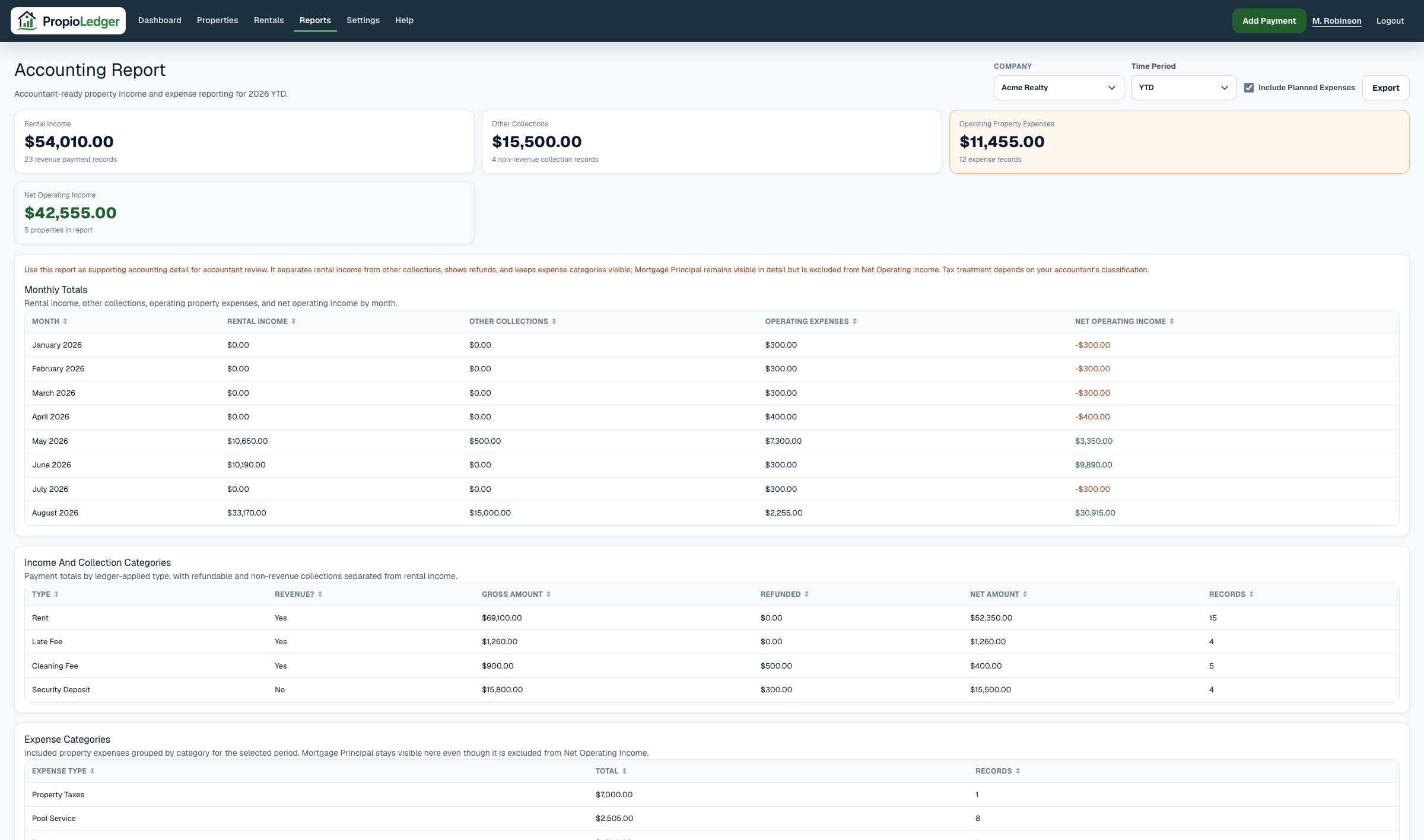
Accounting report
Groups recorded income, other collections, property expenses, and net operating income.
Cash-flow report
Shows money received, property expenses paid, and resulting net cash flow.
Expense analysis
Groups expenses by category, property, and time period.
Property profitability report
Compares income, expenses, net operating income, and net cash flow by property.
Rental ledger
Tracks renter charges, payments, credits, refunds, waivers, open balances, and past-due balances. It serves a different purpose from property expense accounting.
| Report | Primary Question |
|---|---|
| Accounting Report | What income, other collections, and property expenses were recorded? |
| Cashflow Report | How much money came in, went out, and remained? |
| Expense Analysis | Which categories and properties generated the most spending? |
| Property Profitability | Which rentals are producing the strongest financial results? |
| Rental Ledger | What was charged, paid, credited, refunded, waived, or left outstanding for a renter? |
Chart of Accounts vs. Expense Categories
A chart of accounts includes the full financial classification structure. Expense categories are only one portion of it.
For many small landlords, the visible day-to-day experience may feel like choosing income and expense categories. Behind that process, however, the broader chart-of-accounts concept explains why deposits, owner contributions, mortgage principal, and property expenses should remain distinct.
| Chart of Accounts | Expense Categories |
|---|---|
| Includes assets, liabilities, equity, income, and expenses | Includes only costs |
| May support formal accounting statements | Primarily supports spending analysis and tax organization |
| Includes owner and deposit activity | Does not fully explain owner funding or refundable deposits |
| Can include loan and asset accounts | Usually limited to operating and property costs |
How PropioLedger Organizes Rental Financial Activity
PropioLedger uses a rental-specific structure rather than requiring landlords to build a traditional accounting system from scratch.
Landlords can record and review rental income and other payment activity, property-level expenses, expense categories, the person or organization that paid an expense, charges, payments, credits, refunds, waivers, open and past-due renter balances, property cash flow, accounting detail, expense analysis, property profitability, and portfolio performance.
PropioLedger property expense categories include common rental costs such as Loan Payments, Mortgage Interest, Mortgage Principal, Property Taxes, Insurance, HOA Fees, Utilities, Repairs, Maintenance, Improvements, Supplies, yard service, cleaning service, pest control, and other property expenses.
Property expenses remain separate from renter ledger charges. Security deposits remain separate from rental revenue reporting. Known mortgage principal can remain visible without being treated as an operating expense.
This structure gives small landlords consistent rental-specific categories and property-level reporting without implying that PropioLedger currently replaces every function of a full general accounting platform.
A Clearer Way to Organize Rental Property Finances
A chart of accounts is useful only when transactions are recorded consistently. PropioLedger helps landlords organize rental income, property expenses, renter balances, cash flow, and property performance inside one rental-specific workflow.
Educational Disclaimer
This guide is for general educational purposes and is not tax, accounting, legal, or financial advice. Account structures and reporting requirements vary based on ownership, entity structure, accounting method, location, and individual circumstances. Landlords should consult a qualified professional for guidance specific to their situation.