

Key takeaways
- A journal entry records one financial event and identifies the accounts affected.
- Journal entries are posted into the general ledger in traditional accounting workflows.
- Many small landlords never manually create journal entries, but the concept helps explain how accounting systems organize activity.
- Security deposits, owner contributions, mortgage principal, and rental income should not all be treated the same way.
- PropioLedger organizes rental income, property expenses, payment activity, renter balances, cash flow, accounting detail, reporting, and profitability without claiming to generate traditional journal entries.
On this page
- What Is a Journal Entry?
- Why Journal Entries Exist
- How Journal Entries Become a General Ledger
- What Information Does a Journal Entry Contain?
- Simple Journal Entry Examples
- Journal Entries vs Bookkeeping
- Journal Entries vs General Ledger
- Journal Entries vs Chart of Accounts
- Do Small Landlords Need Journal Entries?
- Common Journal Entry Mistakes
- How PropioLedger Organizes Rental Financial Activity
- Educational Disclaimer
- Frequently Asked Questions
What Is a Journal Entry?
A journal entry is an accounting record of a financial event. It explains what happened, when it happened, and which accounts were affected.
For landlords, a financial event might be rent received, a repair bill paid, an insurance premium recorded, a refundable security deposit collected, or owner money added to support a rental property.
In formal accounting, journal entries often use debit and credit columns. Landlords do not need to become accountants to understand the idea. The practical point is that every financial event should be recorded clearly enough that reports and account history can be understood later.
Why Journal Entries Exist
Journal entries exist because financial activity needs a structured way to move from real-world events into organized accounting records.
A bank deposit by itself does not explain whether the money was rent, a refundable deposit, a tenant reimbursement, owner funding, or something else. A journal-entry-style record adds the accounting context.
This structure improves consistency, traceability, and reporting. It helps landlords and their advisors understand why a transaction was recorded the way it was, not merely that money moved.
- Consistency: similar activity can be recorded the same way each time.
- Traceability: reports can be traced back to the underlying event.
- Reporting: income, expenses, deposits, owner activity, and property performance can be summarized more clearly.
How Journal Entries Become a General Ledger
In a traditional accounting workflow, a financial transaction is first recorded as a journal entry. That journal entry is then posted to the general ledger. The general ledger becomes the historical accounting record organized by account, and financial reports summarize that ledger information.
Landlords may not manually see every step, especially when software handles records behind the scenes. The sequence still matters because it explains how individual events become reportable financial history.
Every report ultimately traces back to individual financial events. Understanding this flow helps landlords understand why accurate records matter.
| Step | What It Means for a Landlord |
|---|---|
| Financial Transaction | A real event occurs, such as rent received, an expense paid, or owner money contributed |
| Journal Entry | The event is recorded with the date, description, affected accounts, and amounts |
| Posted to General Ledger | The recorded entry becomes part of account history |
| Financial Reports | Reports summarize the organized account history for review |
Related Guides
Rental Property General LedgerWhat Information Does a Journal Entry Contain?
A useful journal entry contains enough detail to explain the event without forcing the landlord to reconstruct the story later from bank statements, receipts, or memory.
The exact format depends on the accounting system, but the fields below are common in journal-entry-style records.
| Field | Meaning |
|---|---|
| Date | When the financial event occurred or was recorded |
| Description | Plain-language explanation of what happened |
| Accounts affected | The financial categories changed by the event |
| Debit | One side of a formal accounting entry |
| Credit | The other side of a formal accounting entry |
| Reference | Invoice number, receipt number, payment ID, check number, or other lookup detail |
| Property | Rental property connected to the event |
| Notes | Extra context such as vendor detail, renter name, repair explanation, or adjustment reason |
Simple Journal Entry Examples
The examples below are simplified for education. They are not a required chart of accounts, tax treatment, or formal accounting instruction.
Each example shows the plain-English event first, then a simplified journal-entry table. A qualified professional may record items differently based on accounting method, entity structure, loan details, local rules, and the landlord’s specific facts.
Rent payment received
A renter pays $1,550 for monthly rent. In plain English, cash increased and rental income was recognized or recorded according to the landlord’s accounting method.
| Account | Debit | Credit |
|---|---|---|
| Cash or bank account | $1,550 | - |
| Rental income | - | $1,550 |
Repair expense paid
The landlord pays $185 to repair a leaking kitchen shutoff valve. The record should explain the property, vendor, repair category, and reason for the expense.
| Account | Debit | Credit |
|---|---|---|
| Repairs expense | $185 | - |
| Cash or bank account | - | $185 |
Insurance payment
The landlord pays a $175 landlord insurance premium. The payment is recorded as an insurance cost for the rental property.
| Account | Debit | Credit |
|---|---|---|
| Insurance expense | $175 | - |
| Cash or bank account | - | $175 |
Mortgage interest
The landlord uses lender statement detail to identify $1,025 of mortgage interest. Mortgage interest should not be casually mixed with mortgage principal because those items mean different things.
| Account | Debit | Credit |
|---|---|---|
| Mortgage interest expense | $1,025 | - |
| Cash or bank account | - | $1,025 |
Owner contribution
The owner transfers $500 into the rental operating account to cover property costs. That money is owner funding, not rent earned from the property.
| Account | Debit | Credit |
|---|---|---|
| Cash or bank account | $500 | - |
| Owner contribution or equity | - | $500 |
Security deposit received
A renter pays a $1,000 refundable security deposit. If the landlord expects to return it, the deposit is generally tracked separately from earned rental income.
| Account | Debit | Credit |
|---|---|---|
| Cash or deposit account | $1,000 | - |
| Security deposits held | - | $1,000 |
Journal Entries vs Bookkeeping
Bookkeeping is the ongoing process of recording, categorizing, organizing, and reviewing rental financial activity. Journal entries are one possible method used within that process.
A small landlord might never open a screen labeled Journal Entry. Instead, the landlord may record rent payments, add property expenses, review renter balances, and run reports.
Understanding journal entries still helps because it explains the accounting idea behind the workflow: each financial event should be recorded with the right date, category, amount, and context.
Related Guides
Rental Property Bookkeeping GuideJournal Entries vs General Ledger
A journal entry is one accounting event. The general ledger is the broader history of posted events organized by account.
Think of a journal entry as a single page in a diary, while the general ledger is the complete diary organized by topic instead of date.
For example, one repair invoice may be one journal entry. The Repairs account in the general ledger contains that entry along with every other repair entry recorded during the period.
Landlords should care because reports summarize many individual records. If the entries are unclear or inconsistent, the general ledger and reports become harder to trust.
| Journal Entry | General Ledger |
|---|---|
| One accounting event | All posted events organized by account |
| Records what happened on a specific date | Shows account history over time |
| May affect multiple accounts | Accumulates activity inside each account |
| Explains the transaction | Supports reports and historical review |
Related Guides
Rental Property General LedgerJournal Entries vs Chart of Accounts
The chart of accounts, journal entries, and general ledger are related parts of an accounting structure.
The chart of accounts is the list of categories. Journal entries are the transaction records. The general ledger is the history of those records inside the categories.
For landlords, this distinction helps prevent common mistakes such as treating security deposits as rent, owner contributions as income, or mortgage principal as an operating expense.
| Accounting Concept | Plain-English Meaning |
|---|---|
| Chart of Accounts | The list of financial categories, such as Rent, Repairs, Insurance, and Security Deposits Held |
| Journal Entries | The recorded events that use those categories |
| General Ledger | The account history built from posted events |
Related Guides
Rental Property Chart of AccountsDo Small Landlords Need Journal Entries?
Many small landlords never manually create journal entries. They record rent, record expenses, track renter balances, and review reports instead.
That can be perfectly practical, especially for landlords with a small portfolio and straightforward records. The goal is not to turn every landlord into an accountant.
Understanding journal entries is still useful because it explains how accounting systems organize information. It also helps landlords understand why categories, dates, property assignments, deposit treatment, and owner activity matter.
If a landlord needs formal financial statements, complete double-entry accounting records, depreciation accounting, trial balances, or entity-level accounting, they should work with a qualified professional and appropriate accounting tools.
Common Journal Entry Mistakes
Journal-entry mistakes usually happen when the real-world event is not described clearly or when different types of activity are treated as if they were the same.
Even landlords who never manually create journal entries can avoid these mistakes by keeping rental records consistent and property-specific.
| Mistake | Better Approach |
|---|---|
| Recording duplicate entries | Review existing transactions before adding corrections or adjustments |
| Mixing owner money with rental income | Track owner contributions separately from rent earned by the property |
| Treating deposits as rent | Keep refundable security deposits separate from earned rental income |
| Treating mortgage principal as an operating expense | Separate known principal from mortgage interest when statement detail is available |
| Missing descriptions | Add notes that explain what happened and why |
| Using the wrong dates | Record the transaction date consistently and preserve supporting documentation |
| Using inconsistent categories | Use stable categories from month to month |
| Ignoring property assignment | Tie property-related activity to the correct rental property |
How PropioLedger Organizes Rental Financial Activity
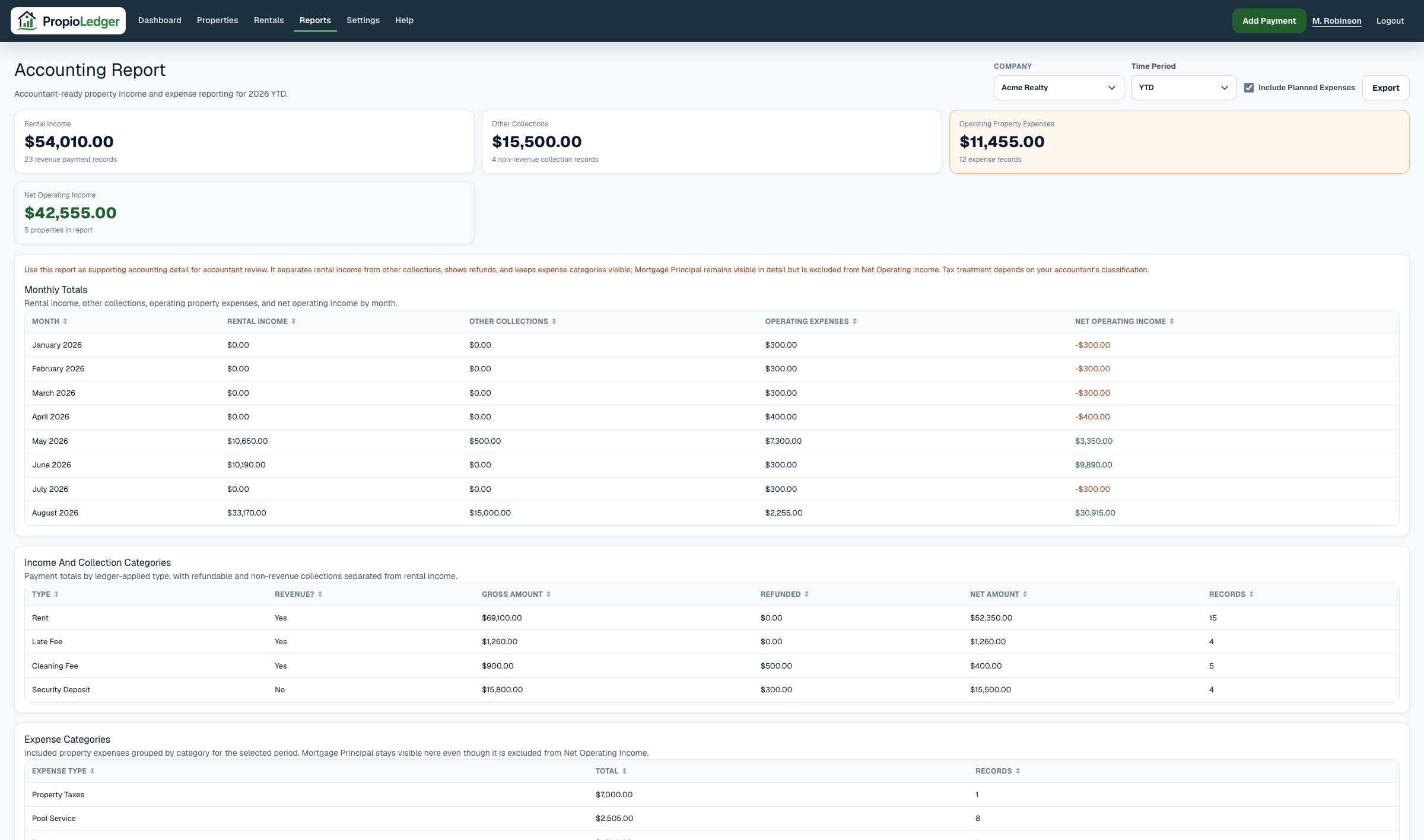
PropioLedger focuses on rental operations and rental-specific financial organization. It helps landlords organize rental income, expenses, payment activity, renter balances, cash flow, reporting, accounting detail, and property profitability.
PropioLedger should not be described as currently generating journal entries, posting entries to a traditional general ledger, replacing double-entry accounting software, producing a trial balance, producing a formal balance sheet, handling bank reconciliation, or providing a customizable chart of accounts.
Instead, PropioLedger gives landlords structured rental records: property-level expenses, rental income and payment activity, renter balances, cash-flow views, accounting reports, expense analysis, property profitability, and related reporting.
Understanding journal entries can still help landlords understand how accounting systems are structured. PropioLedger simply approaches the problem through rental operations and property-level financial workflows rather than traditional accountant-only screens.
Understand Your Rental Finances More Clearly
Whether or not you ever create a journal entry yourself, understanding how rental financial records fit together makes it easier to manage expenses, interpret reports, and make better investment decisions.
Educational Disclaimer
This guide is for general educational purposes and is not tax, accounting, legal, or financial advice. Accounting records and reporting requirements vary based on ownership, entity structure, accounting method, location, and individual circumstances. Landlords should consult a qualified professional for guidance specific to their situation.