
Key takeaways
- A rental property income statement summarizes income and expenses over a period of time.
- Income statement and profit and loss statement, or P&L, generally refer to the same type of financial report.
- Rental income minus applicable expenses produces a measure of profit or loss, but landlords should distinguish operating performance from cash flow and taxable income.
- Reviewing income statements by individual property can reveal differences that disappear when an entire portfolio is combined.
- Accurate bookkeeping and consistent expense categorization make income statements more useful.
On this page
- What Is a Rental Property Income Statement?
- How Rental Activity Becomes an Income Statement
- Income Statement vs Profit and Loss Statement (P&L)
- What Goes on a Rental Property Income Statement?
- Rental Property Income Statement Example
- How to Read a Rental Property Income Statement
- Income Statement vs Balance Sheet
- Income Statement vs Cash Flow Statement
- Income Statement vs General Ledger
- Income Statement vs Rent Roll
- Why Property-Level Income Statements Matter
- Common Rental Property Income Statement Mistakes
- Best Practices for Rental Property Income Statements
- From Bookkeeping to Financial Reporting
- How PropioLedger Helps
- Educational Disclaimer
- Frequently Asked Questions
What Is a Rental Property Income Statement?
A rental property income statement is a financial report that summarizes income and expenses for a rental property over a defined period, such as a month, quarter, year, or year-to-date period. It helps landlords see whether the rental operation produced a profit or loss during that period.
An income statement is also commonly called a profit and loss statement or P&L. In rental property conversations, landlords may also hear terms such as rental income statement, rental property P&L, property income statement, or rental property income and expense statement.
The basic operating relationship is simple: Rental Income + Other Property Income - Operating Expenses = Net Operating Income (NOI). NOI is not the same as net income, taxable income, or cash flow because financing costs, depreciation, taxes, loan principal, and cash timing can be handled separately depending on the report.
Unlike a rental property balance sheet, which shows financial position at a specific point in time, an income statement explains what happened financially during a period. It helps answer how much income the property generated, what it cost to operate, which expenses changed, whether the property was profitable, and how one period or property compares with another.
Landlords use income statements to understand property performance, compare rental properties, monitor income and expenses, identify expense changes, support tax preparation, provide records to accountants, support lender or investor review, and make operating decisions.
How Rental Activity Becomes an Income Statement
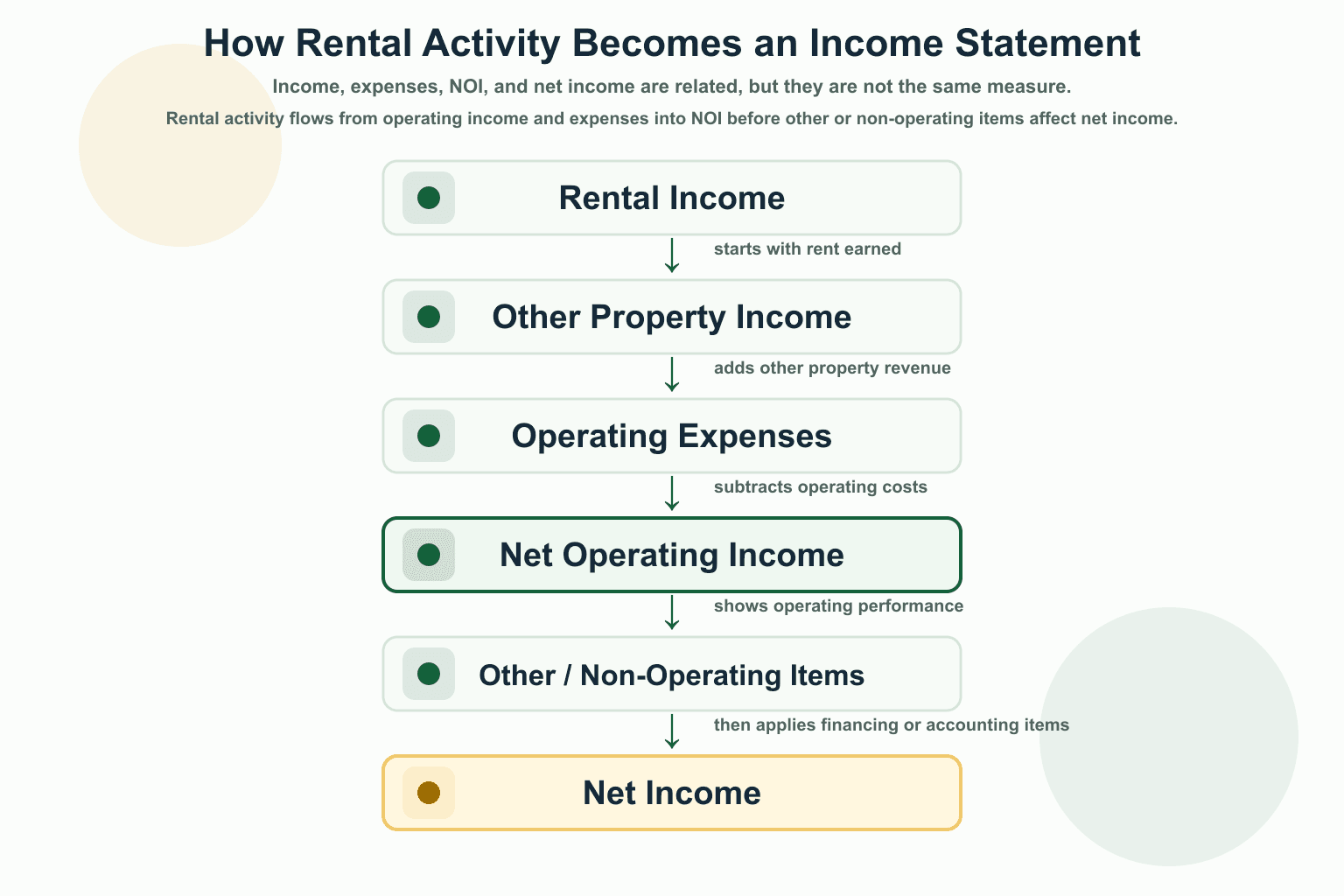
Rental property reports are most useful when the major measures stay distinct. Rental income, other property income, operating expenses, net operating income, other or non-operating items, and net income are related, but they do not all answer the same question.
The infographic below shows a simplified educational flow. It highlights Net Operating Income and Net Income separately because NOI generally describes operating performance before financing costs, income taxes, depreciation, and certain other non-operating items, while net income may include additional items depending on the report.
Income Statement vs Profit and Loss Statement (P&L)
Income statement, profit and loss statement, and P&L are commonly used for the same general type of report. The terms may differ among landlords, accountants, bookkeeping systems, lenders, and property management systems.
The name matters less than the contents. A landlord should understand the reporting period, which income categories are included, which expense categories are included, and whether the statement stops at operating profit or continues to other items such as interest or depreciation.
What Goes on a Rental Property Income Statement?
A rental property income statement usually begins with income, subtracts expenses, and then shows one or more profit measures. The level of detail depends on whether the statement is used for monthly management, accountant review, lender review, tax preparation support, or portfolio analysis.
Not every fee or collection should automatically be treated as rental income. Accounting and tax treatment can vary based on the facts, the landlord’s accounting method, applicable rules, and professional guidance.
| Category | Examples | What It Shows |
|---|---|---|
| Rental Income | Monthly rent, nightly rent where applicable, prorated rent | Core rental revenue generated by use of the property |
| Other Property Income | Parking, pet rent, laundry, application or administrative income, other recurring property-related income | Additional property-related income when applicable |
| Operating Expenses | Repairs and maintenance, property management, insurance, utilities paid by owner, landscaping, cleaning, HOA expenses, advertising, supplies, professional services | Costs of operating the rental property during the reporting period |
| Other / Non-Operating Items | Interest expense, depreciation, gains or losses, other financing or accounting items where applicable | Items that may appear below operating performance depending on reporting purpose |
Rental Property Income Statement Example
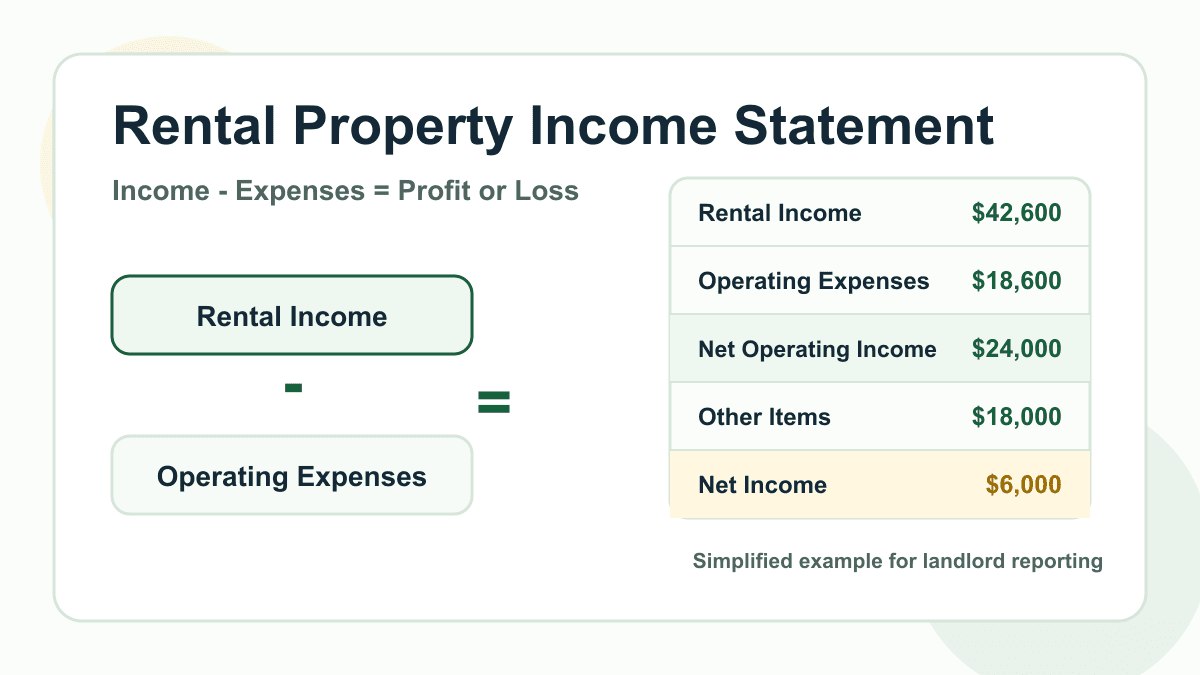
The rental property income statement example below is simplified, fictional, and educational. It shows how rental income, operating expenses, NOI, and illustrative below-NOI items can appear together for one property.
Actual income statements can categorize expenses differently, and tax reporting may differ from management reporting. Interest, depreciation, taxes, and other items should be reviewed with a qualified professional when preparing formal financial or tax records.
| Section | Line Item | Amount |
|---|---|---|
| Property | Oak Street Duplex | |
| Period | January 1-December 31, 2026 | |
| Rental Income | Gross Rent | $42,000 |
| Rental Income | Other Property Income | $600 |
| Total Income | Total Income | $42,600 |
| Operating Expenses | Repairs & Maintenance | $3,200 |
| Operating Expenses | Insurance | $2,400 |
| Operating Expenses | Property Taxes | $5,500 |
| Operating Expenses | Utilities | $1,800 |
| Operating Expenses | Landscaping | $1,200 |
| Operating Expenses | Property Management | $3,400 |
| Operating Expenses | Other Operating Expenses | $1,100 |
| Total Operating Expenses | Total Operating Expenses | $18,600 |
| Net Operating Income | Net Operating Income | $24,000 |
| Below NOI Items | Interest Expense | $8,000 |
| Below NOI Items | Depreciation | $10,000 |
| Net Income | Illustrative Net Income Before Other Tax Adjustments | $6,000 |
In this simplified example, Oak Street Duplex generated $42,600 in total income and $18,600 in operating expenses, producing $24,000 of NOI. After the illustrative interest and depreciation amounts shown below NOI, the example reports $6,000 of net income before other tax adjustments.
That does not mean the property generated only $6,000 of cash flow, because depreciation is a non-cash expense and loan principal and other cash movements may be treated separately.
How to Read a Rental Property Income Statement
Read a rental property income statement from top to bottom. Start with income, then expenses, then operating profit, then any additional items below operating performance.
Step 1: Review Income
Ask whether scheduled rent is being collected, whether income changed from the prior period, whether vacancies affected rental income, and whether other income sources are material enough to review separately.
Step 2: Review Expenses
Look for unusually large expenses, categories increasing over time, recurring versus one-time costs, and differences between properties. A repair spike may be reasonable in one month but worth investigating if it repeats.
Step 3: Review NOI
NOI generally measures property operating income before financing costs, income taxes, depreciation, and certain other non-operating items. It helps isolate operating performance before the landlord’s financing structure changes the picture.
Step 4: Review Net Income
Net income may include items that are excluded from NOI, depending on how the statement is structured. That is why NOI, net income, cash flow, and taxable income should not be treated as interchangeable.
Step 5: Compare Periods
Compare month versus previous month, year-to-date versus prior year, current year versus prior year, and property versus property. A single statement is useful, but trend comparison usually reveals more.
Income Statement vs Balance Sheet
An income statement and balance sheet are both financial statements, but they answer different questions. The income statement covers activity during a period. The balance sheet shows financial position at a point in time.
| Topic | Income Statement | Balance Sheet |
|---|---|---|
| Purpose | Shows income, expenses, and profit or loss | Shows what the property or rental business owns and owes |
| Timeframe | Covers a period such as a month, quarter, year, or year-to-date period | Shows a point-in-time snapshot |
| Income | Primary part of the report | Usually not shown as period income |
| Expenses | Primary part of the report | Usually not shown as period expenses |
| Assets | Usually not the focus | Primary part of the report |
| Liabilities | Usually not the focus | Primary part of the report |
| Equity | May be affected by profit or loss over time | Primary part of the report |
| Primary Question | What happened financially during this period? | What does the property or business own and owe at this point in time? |
Related Guides
Rental Property Balance SheetIncome Statement vs Cash Flow Statement
Profit and cash flow are not the same thing. A rental property can show positive income while actual cash movement looks different because of loan principal payments, capital expenditures, receipt and payment timing, or non-cash expenses such as depreciation.
Cash movement alone also does not necessarily describe accounting profitability. For example, mortgage principal reduces cash, but it is generally a financing or balance-sheet item rather than an operating expense. Depreciation can reduce accounting income without requiring a cash payment during the period.
Landlords should review income statements and cash flow reports together. The income statement helps explain profitability, while cash flow helps explain money moving in and out.
Income Statement vs General Ledger
An income statement summarizes financial results. A general ledger is the underlying accounting activity organized by accounts.
The relationship is: Transactions -> Journal Entries / Recorded Activity -> General Ledger -> Income Statement. The income statement summarizes selected income and expense accounts from the accounting records.
Small landlords may not maintain formal journal entries in the same way a full accounting system does, but the concept still matters: cleaner recorded activity produces cleaner reports.
Income Statement vs Rent Roll
A rent roll is a current operational snapshot of units, rents, tenants, occupancy, lease dates, and related rental information. An income statement shows financial performance over a period.
Both can be useful together. The rent roll helps explain what should be generating rental income, while the income statement shows the financial results recorded over the reporting period.
Why Property-Level Income Statements Matter
Combining every rental property into one portfolio income statement can hide important differences. A portfolio total may look healthy while one property is underperforming, experiencing high repairs, or carrying vacancy problems.
For example, a portfolio might show $180,000 of income, $105,000 of expenses, and $75,000 of profit. That sounds strong. But property-level reporting could reveal Property A with $40,000 of profit, Property B with $30,000 of profit, and Property C with only $5,000 of profit. In another portfolio, one property could be losing money while another property masks the problem.
Property-level income statements help landlords identify unusually high repairs, weak rental income, high vacancy, increasing insurance, utility problems, management-cost differences, and underperforming properties.
| View | Income | Expenses | Profit |
|---|---|---|---|
| Combined portfolio | $180,000 | $105,000 | $75,000 |
| Property A | $70,000 | $30,000 | $40,000 |
| Property B | $65,000 | $35,000 | $30,000 |
| Property C | $45,000 | $40,000 | $5,000 |
Common Rental Property Income Statement Mistakes
Income statements become less useful when the underlying bookkeeping is inconsistent, incomplete, or mixed across properties. The goal is not to make the report complicated. The goal is to make it reliable enough for decisions.
| Mistake | Why It Matters |
|---|---|
| Mixing personal and rental expenses | The statement no longer reflects rental property performance clearly |
| Combining every property without property-level detail | Strong properties can hide weak or losing properties |
| Inconsistent expense categories | Trends become harder to compare from month to month or year to year |
| Confusing loan principal with an operating expense | Operating profit can be understated and NOI can be distorted |
| Treating security deposits automatically as rental income | Refundable deposits may need separate treatment depending on the circumstances and applicable rules |
| Confusing NOI with cash flow | Operating performance and actual cash movement answer different questions |
| Ignoring one-time expenses | Large unusual costs can distort period comparisons if they are not understood |
| Comparing periods that cover different lengths of time | A six-month result should not be compared casually with a full-year result |
| Not reconciling underlying bookkeeping records | Income statement totals may not agree with payment, expense, ledger, or bank records |
Best Practices for Rental Property Income Statements
A useful landlord income statement is consistent, property-specific, and connected to the underlying rental records. Consistency matters more than creating an overly complicated report.
- Review income statements monthly.
- Review year-to-date results before year-end.
- Keep income and expense categories consistent.
- Separate properties instead of relying only on portfolio totals.
- Reconcile income with rental and payment records.
- Reconcile expenses with bills, receipts, and property records.
- Compare current periods with prior periods.
- Investigate large changes before they become normal.
- Preserve supporting records for accountant, lender, or owner review.
- Coordinate with an accountant or bookkeeper when the report will support formal accounting or tax work.
From Bookkeeping to Financial Reporting
A rental property income statement is easier to trust when it is built from organized records. The reporting chain usually starts with account structure, then transactions, then recorded activity, then summary reports.
The relationship is: Chart of Accounts -> Transactions -> Journal Entries / Recorded Activity -> General Ledger -> Income Statement and Other Financial Reports.
The articles below explain each part of that accounting content cluster without requiring every landlord to use a full enterprise accounting system.
How PropioLedger Helps
PropioLedger helps landlords organize properties, rentals, payments, rental income, property expenses, expense categories, cash flow, profitability, and property-level reporting.
Keeping rental activity organized by property makes financial performance easier to review. Instead of looking only at portfolio totals, landlords can connect rental income, expenses, cash flow, balances, and profitability back to the properties that created them.
PropioLedger is designed to give landlords a clearer view of rental activity and property-level financial performance while keeping the underlying rental records connected.
Understand How Each Rental Property Is Performing
PropioLedger organizes rental income, expenses, cash flow, and property-level financial reporting so landlords can see what is happening across their rental portfolio.
Educational Disclaimer
This guide is for general educational purposes and is not tax, accounting, legal, or financial advice. Landlords should consult a qualified professional for guidance specific to their situation.